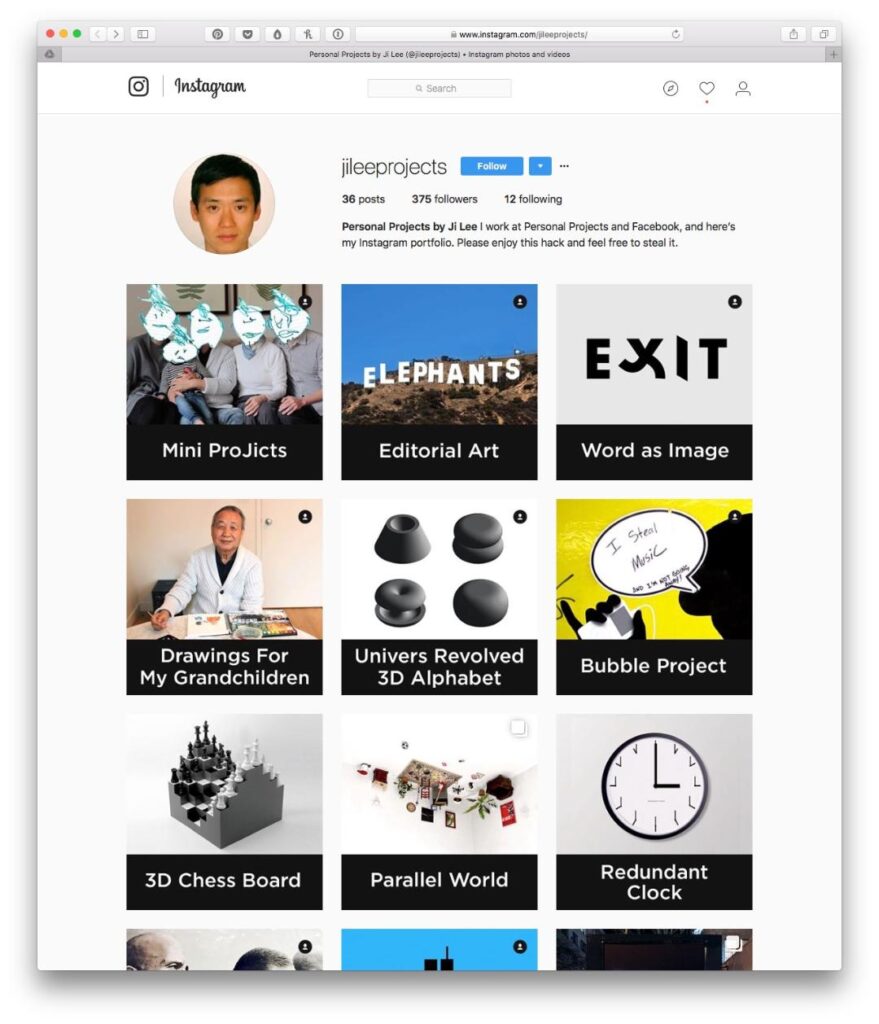
Using multiple accounts on Instagram, artist Ji Lee built his website and folio. Here is his official website. We like the URL 😀

We agree with John. Points 6 and 8 are our favs 🙂

As someone who has decades of experience on the web, I hate to compare myself to the tortoise, but hey, if it fits, it fits. Let’s be more like that tortoise: diligent, direct, and purposeful. The web needs pockets of slowness and thoughtfulness as its reach and power continues to increase. What we depend upon must be properly built and intelligently formed. We need to create space for complexity’s important sibling: nuance. Spaces without nuance tend to gravitate towards stupidity. And as an American, I can tell you, there are no limits to the amount of damage that can be inflicted by that dangerous cocktail of fast-moving-stupid.
—Frank Chimero
Frank Chimero writes on how everything easy is hard again. We believe the above quote applies to our overall life as well, not just the web.

Despite YouTube and Amazon’s efforts, record numbers of teens are still eating Tide Pods. Hey, even we feel like popping one in the mouth. It looks delicious! Maybe Tide knew what it was doing. As the saying goes: Any publicity is good publicity. What do you think?
Via The Verge
Comedian Tim Minchin reveals the only rational thing you should do with your time here on Earth in nine hilarious and wise life lessons. We like the part about dreams and ambitions in particular.
I never really had one of these dreams. I advocate passionate dedication to the pursuit of short-term goals. Be micro-ambitious. Put your head down and work with pride on whatever is in front of you. You never know where you might end up. Just be aware the next worthy pursuit will probably appear in your periphery, which is why you should be careful of long-term dreams. If you focus too far in front of you, you won’t see the shiny thing out of the corner of your eye.
The 9 lessons:
Watch or read the whole thing here.
I began to appreciate time. There is nothing more wonderful to have in one’s life, than time. I don’t believe people get enough of it nowadays. I was excessively fortunate in my childhood and youth, just because I had so much time. You wake up in the morning, and even before vou are properly awake vou are saying to vourself: “Now, what shall I do with today?” You have the choice, it is there, in front of you, and you can plan as you please. I don’t mean that there were not a lot of things (duties, we called them) I had to do-of course there were. There were jobs to be done in the house: days when you cleaned silver photograph frames, days when you darned your stockings, days when you learnt a chapter of Great Events in History, a day when you had to go down the town and pay all the tradesmen’s bills. Letters and notes to write, scales and exercises, embroidery—but they were all things that lay in my choice, to arrange as I pleased. I could plan my day, I could say, “I think I’ll leave my stockings until this afternoon: I will go down town in the morning and I will come back by the other road and see whether that tree had come into blossom yet.” Always when I woke up, I had the feeling which I am sure must be natural to all of us, a joy in being alive. I don’t say you feel it consciously-you don’t—but there you are, you are alive, and you open your eyes, and here is another day; another step, as it were, on your journey to an unknown place. That very exciting journey which is your life. Not that it is necessarily going to be exciting as a life, but it will be exciting to you because it is your life. That is one of the great secrets of existence, enjoying the gift of life that has been given to you.
—Agatha Christie
How beautifully put! Wish we’d written this. From her autobiography.
John Maeda has noted two Georges’ way of thinking about problems in their respective fields–Mathematics and Research. We see both these sets of questions fitting perfectly with marketing, business and life too.
George Pólya’s questions for problem solving in mathematics:
Understand the problem
• What is the unknown?
• What are the data?
• What is the condition?
• Can the problem be solved?
Assumptions
• What can you or need you assume?
• What shouldn’t you assume?
• Have you made subconscious assumptions?
Devising a plan of attack
• Have you seen this or a related problem before?
• Have you seen a similar unknown before?
• Can you restate the problem?
• If you can’t solve this problem, can you solve a similar or simpler problem?
Aftermath
• Are you sure of the solution? Can you see it at a glance?
• Did you use all the data? the whole condition?
• Can you get the same solution another way?
• Are there other valid solutions?
• Can you apply the solution or method to another problem?
• Was this a satisfying problem to solve?
.
George Heilmeier’s list of questions for solving research challenges:
Suzanne LaBarre gives Dieter Rams’s design principles a 21st century upgrade in this article on Fast Company. We consider principles 7 and 8 in particular to be very relevant.
One. GOOD DESIGN IS TRANSPARENT
User-friendly design has been the dominant paradigm in human-computer interaction for decades, and for good reason: It reduces complex code into a simple language anyone can understand. But today, amid a string of high-profile data breaches and opaque algorithms that threaten the very bedrock of democracy, consumers have grown wary of slick interfaces that hide their inner workings. “For years there was such a huge UX trend toward seamlessness and concealing as much as possible in the interest of making things user-friendly,” Ame Elliott, design director of the nonprofit Simply Secure, said last year. “Now, as discipline, interaction designers and UX experts have a lot of hard work to do to think about how to expose those seams in appropriate ways.” Good design should be transparent enough to empower users–to help them make informed decisions about their privacy, their browsing habits, and more–without overwhelming them.
Two. GOOD DESIGN CONSIDERS BROAD CONSEQUENCES
Another problem with user-friendly design: In focusing on the immediate needs of users, it often fails to consider long-term consequences. Take Facebook’s echo chamber, Airbnb’s deleterious impact on affordable housing, or the smartphone, which is literally changing people’s brains and has spawned an entire generation of teenage automatons.
Good design chases more than clicks. It’s mindful of potential impact–whether economic, social, cultural, or environmental–and it’s mindful of that impact over time. There’s one simple test, according to Rob Girling and Emilia Palaveeva of the design consultancy Artefact: “Don’t just ask ‘how might we?’” they write, invoking a common term of art in design thinking. “Ask, ‘At what cost?’”
Three. GOOD DESIGN IS SLOW
For the past 20 years, tech has embraced a “move fast and break things” mantra. That was fine when software had a relatively small impact on the world. But today, it shapes nearly every aspect of our lives, from what we read to whom we date to how we spend money–and it’s largely optimized to benefit corporations, not users. The stakes have changed, the methods haven’t. Good design takes time. It favors long-term solutions over quick fixes. As Basecamp designer Jonas Downey puts it: “Now it’s time to slow down and take stock of what’s broken.”
Four. GOOD DESIGN IS HONEST
This is one of Rams’s tenets, but it bears repeating at a time when dark patterns abound and corporations treat UX like a weapon. Uber is the most flagrant example. The company built its business on a seamless front-end user experience (hail a ride, without ever pulling out your wallet!) while playing puppet master with both users and drivers. The company’s fall from grace–culminating in CEO Travis Kalanick’s ousting last year–underscores the shortsightedness of this approach.
Good design “does not make a product more innovative, powerful or valuable than it really is,” Rams writes. “It does not attempt to manipulate the consumer with promises that cannot be kept.”
Five. GOOD DESIGN IS POLITICAL
“If you work in software or design… you also work in politics.” That was British designer Richard Pope writing at the end of 2016 after the surprise election of Donald Trump, but the point remains relevant more than a year later: Politics is about the distribution of power, and few things distribute power more broadly and rapidly in the 21st century than code and design. Facebook’s role in shaping the outcome of the presidential election is one obvious example. But you can find subtler examples all over the place, from ads targeting men for higher paying jobs to predictive policing software that indicts black people more than white people.
Good design is upfront about its potential to shape the political landscape.
Six. GOOD DESIGN IS MINDFUL OF SYSTEMS
Systems thinking is a lofty term for a relatively simple idea: Everything is connected, and designers and developers should strategize accordingly. Systems thinking has taken on even greater import over the past few years, as the world becomes more complex and intertwined. Consider that we generate 2.5 quintillion bytes of data a year, more than 90% of which was created in just the past two years. Today, nearly half of all adults own a smartphone; by 2020, that figure is expected to climb to 80%.
Good design, then, is no longer about solving discrete problems: It’s about considering the sum of the parts. “The challenge is to rise above the distraction of the details and widen your field of vision,” writes Foundation Capital partner Steve Vassallo. “Try to see the whole world at once and make sense of it. It’s a heady challenge, but you either design the system or you get designed by the system.”
Seven. GOOD DESIGN IS GOOD WRITING
In his “2017 Design in Tech Report,” author John Maeda anointed writing as design’s newest unicorn skill. It’s easy to see why. With the rise of chatbots and conversational UI, writing is often the primary interface through which users interact with a product or service. (Siri’s dad jokes had to be written by someone.) But even designers who don’t work on interface copy should be able to articulate themselves clearly. The better their writing, the better their chances of selling an idea.
Eight. GOOD DESIGN IS MULTIFACETED
The days of brands peddling a single identity are gone. The Emotional Intelligence Agency, a U.K.-based branding firm, analyzed the brands that more than 5,000 people said they sought out. The results were surprisingly consistent. Top brands, from Victoria’s Secret to Taco Bell, had four seemingly disparate traits: humor, usefulness, beauty, and inspiration. The takeaway? In an increasingly complex retail landscape, brands must adopt multifaceted personalities to connect emotionally with consumers.
Nine. GOOD DESIGN TAKES RISKS
Ideo studied more than 100 companies in an attempt to quantify innovation and came away with six key insights. Among them? Challenging the status quo has real business benefits. According to the study, chances of a failed product launch decreased by 16.67% when people felt comfortable acting with autonomy.
Ten. GOOD DESIGN IS FOR PEOPLE—AND MACHINES
Historically, computers have been designed for human users. But as machines grow smarter and artificial intelligence takes root in people’s daily lives, designers will have to build for a new type of user: the human-machine hybrid. So suggests Normative CEO Matthew Milan, who argues that hybrids can do more than any person or computer could accomplish alone, like navigate traffic or compete in superpowered chess games.
Looking ahead, good design will help people trust a system–even when they know they don’t have much agency within it.
I love language and I love ideas that are simple. Simple ideas communicate in a simpler way.
—Dean Poole
A heads-up: This video is 34 minutes long. But all kinds of fun, if you are into language, play and creativity. Read more about the talk and Dean Poole here.

Dog Ear is a UK-based magazine. It collects written and illustrated submissions and prints every three months. After that, it’s adopts clever, guerrilla approach to distribution: Dog Ear is usually found lurking in libraries and bookshops, or nestled between pages of other magazines.
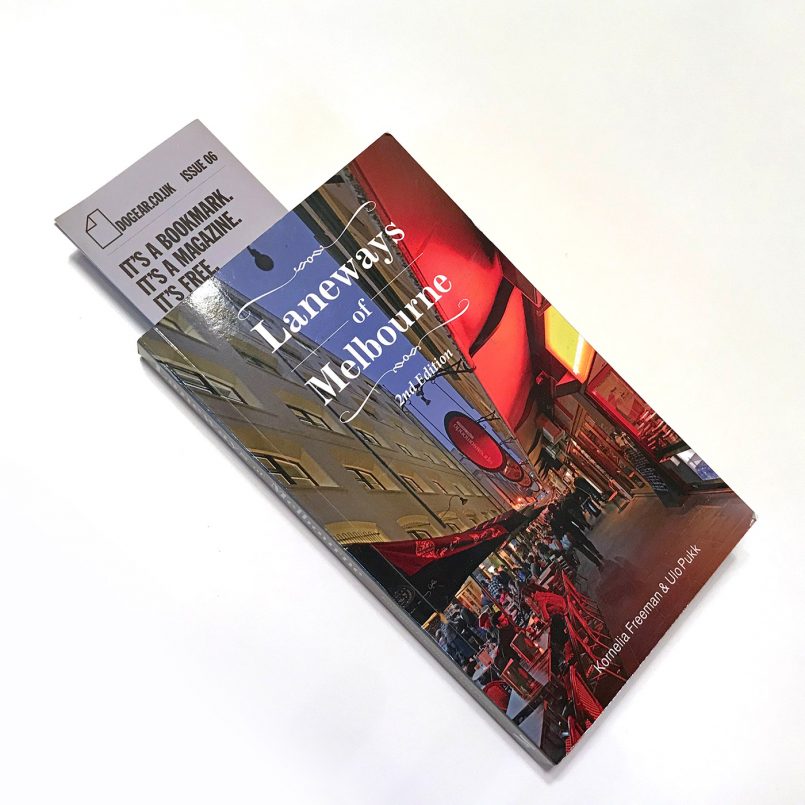
We love it!