
We love icons. Samples from an ongoing series on Noun Project called India in Icons. Download them here. If you want customised icons for your brand, contact us here.

This is a typeface we designed with the basic character set. The experiment was to see how our mind derives meaning from shapes. Where does a shape end, and the language begins? Have you already spotted the hidden message in the image? Too many questions? Ok, we will stop now 🙂
I learned about cars, robots, food, soap, toys, cigarettes, sweets, fountain pens, timber, fish, newspapers, oil, wine, nuclear fuel, the army, the police. I visited hospitals, refugee hostels, sweet factories, oil refineries and nuclear plants, was taught how to drive a Land Rover through a river, how to fire the cannon of a Centurion tank and have sat quaking in a police car during a high-speed chase. I learned how the insurance and banking systems work, as well as about human rights, our plundered environment and the scandal of places like Bhopal. Through my work l learned about the deep interconnectedness of these things. Society is a web of myriad causes and effects. Tugging at a thread on this side of the web can twitch apparently unrelated strands on the far side. Quite by accident l discovered that the copywriter has real power in the world.

In case you were wondering, this is Indra Sinha, one of the advertising greats from a powerful article he wrote: How copywriters can change the world.
Everyone always talks about confidence in believing what you do. I remember once going to a class in yoga where the teacher said that, spirituality speaking, if you believed that you had achieved enlightenment you have merely arrived at your limitation. I think that is also true in a practical sense. Deeply held beliefs of any kind prevent you from being open to experience, which is why I find all firmly held ideological positions questionable. It makes me nervous when someone believes too deeply or too much. I think that being skeptical and questioning all deeply held beliefs is essential. Of course we must know the difference between skepticism and cynicism because cynicism is as much a restriction of one’s openness to the world as passionate belief is.

In case you were wondering, this was by the man who led Milton Glaser Inc. in one of his many enlightening essays on his website.
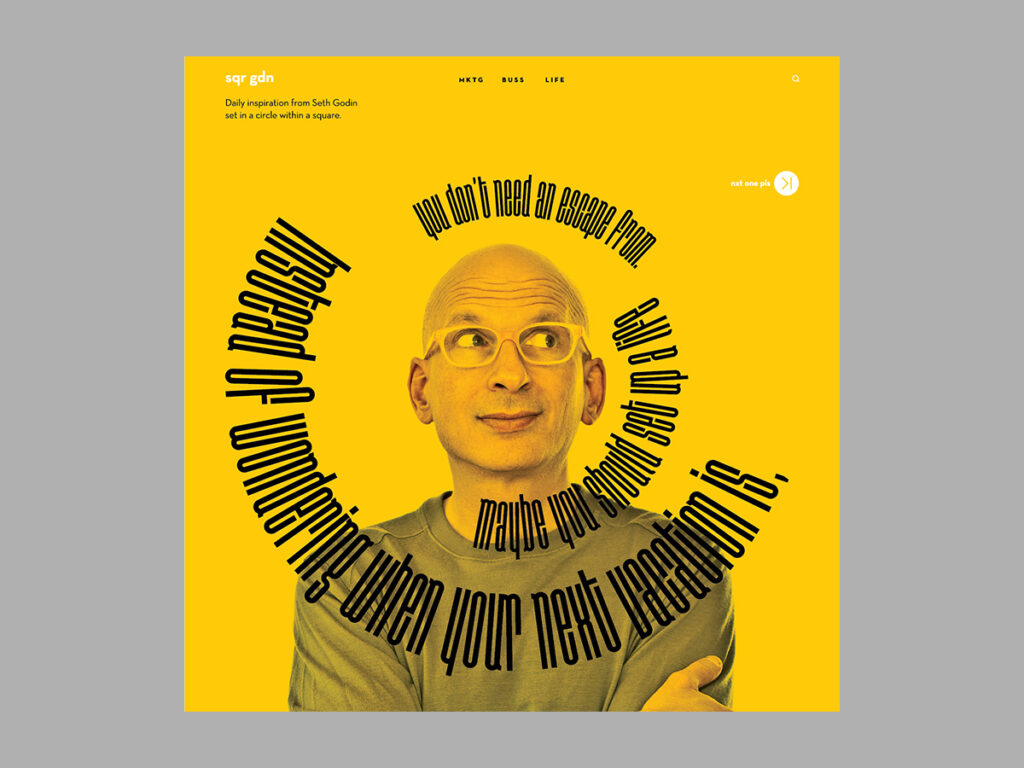
Have you tried the Square Interface Game yet? Do it, it’s fun. This is our interface design concept, using Seth Godin and his perspectives on business, marketing and life for inspiration.
One of the most interesting parts of his story is that he now looks back on his career with some regret. “If I had to do it over again, I would not want to be a designer,” he’s said. “There are too many unnecessary products in this world.” He has long been an advocate for the ideas of environmental consciousness and long-lasting products. He’s dismayed by today’s unsustainable world of over-consumption, where “design” has been reduced to a meaningless marketing buzzword.

In case you were wondering, this is Dieter Rams talking about product design and consumerism in Rams, a documentary by Gary Hustwit.

Don’t try this at home or anywhere else. That is not the message. But it goes on to show that our mind is an ocean. You never know what you will find when you explore its depth. Maybe the idea is to stay curious, observant and be surprised with what it has to offer.
Under the influence by Bryan Lewis Saunders.
I strongly believe that the amount of love and care you put into a project is always apparent. Even if people are not conscious of it, they can sense when you have paid attention to every little detail.
—Jocelyn K. Glei
The grid system is an aid, not a guarantee. It permits a number of possible uses and each designer can look for a solution appropriate to his personal style. But one must learn how to use the grid; it is an art that requires practice.
—Josef Müller-Brockmann
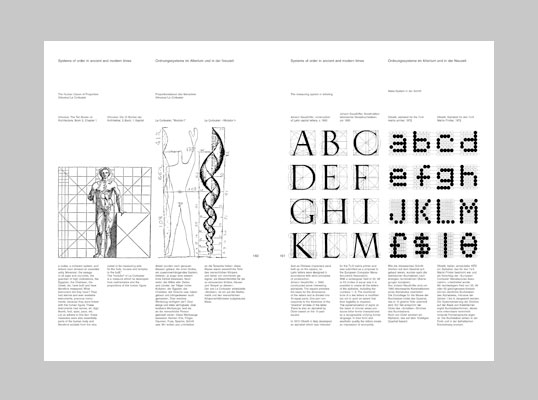
From a professional for professionals, here is the definitive word on using grid systems in graphic design. Though Muller-Brockman first presented hi interpretation of grid in 1961, this text is still useful today for anyone working in the latest computer-assisted design. With examples on how to work correctly at a conceptual level and exact instructions for using all of the systems (8 to 32 fields), this guidebook provides a crystal-clear framework for problem-solving.
The go-to book for grid-based graphic design. Special mention: pages 129-144 show you how to use it for exhibitions.
Via Design Open Data
