• Big Data

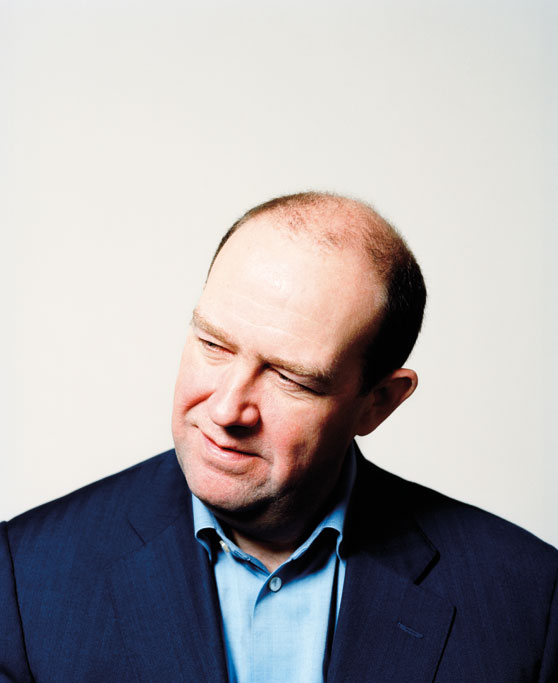
    Guy Laurence, ex-CEO Vodafone UK on Data

    A thoroughly engaging article from 2011 by Simon Rogers when the term information overload was new, and big data had not found a place in our daily conversation. Mr. Guy Laurence, then CEO of Vodafone UK shared his unique relationship with numbers and customers in this article, and talked about on how to use data to drive business decisions effectively. The Q&A session at the end, fun 🙂 From the very first issue (Data) of Think series from Google (Think Quarterly), which has now evolved into Think with Google.

    Posting a part of the article here. A fascinating read. Check out the whole thing here.

    A few seconds after midnight on New Year’s Eve, 2010. Numbers start flying across a bank of screens in a large darkened room. London: 1,170,000; Glasgow: 115,000; Manchester: 75,000; Leeds: 70,000… The numbers scroll on as the black-clad tech team look for signs that the system might not be able to cope.

    It could be a scene from futurist cult film Minority Report, but the room is actually a real one – at Vodafone’s state-of-the-art Network Operations Centre in Newbury, Berkshire – and the figures represent the number of texts sent in the first 30 minutes of 2011. This is pure data in action.

    The man responsible for this scene is obsessed with data – because of what the numbers can help him do, rather than with the ones and zeros themselves. “I don’t have a relationship with numbers, I have a relationship with customers,” says Guy Laurence, the 49-year-old who took over as CEO of Vodafone UK in 2009. “I focus totally on human responses to things; if you smack someone in the face, what would they do? If you kiss them on the cheek, what would they do?”

    Laurence took over a company widely seen as stagnating in third place in the UK’s competitive mobile market. Today, Vodafone is viewed as a powerful success story, with more than 19 million customers across the country. When you’ve got that many customers, the big question is: how do you industrialise something that works for each one? “You can always kiss one customer on the cheek – but how do you kiss 19 million customers on the cheek?” he asks.

    Laurence carries only a few numbers in his head: his company’s ‘net promoter score’ (which tells him exactly how well Vodafone is really doing with its customers) and the competition’s market revenue share. “When you run a £5 billion company you can’t avoid numbers – but if you start with numbers you’ll never innovate,” he says. “You have to take the action you think will work and the numbers follow.”

    Even when he’s about to fly off with his family to live rough in the Masai Mara for a week, for Laurence, it’s all about focus. He left school with one grade E A-level, having fluffed his exams by setting up a candle-making business after he realised that “making money was much more fun”. It’s a pattern repeated when he quit his degree to work for independent music publisher Chrysalis. Eventually he became head of distribution and marketing outside America at MGM. His job was to work out which markets a product would work in.

    He will tell you, for instance, that a baseball movie will only work outside the US if it’s shown in Japan. He worked on the Bond films, including GoldenEye, selling them to reluctant cinema owners who hadn’t screened anything from the franchise in six years. “The last film had been [classified as] a 15. Therefore anyone under 21 had never seen a Bond film in a cinema.” So MGM made it cool – selling the film to teenagers, dads and mums simultaneously with targeted campaigns that fuelled interest.

    As Laurence explains, it’s all about making the data work. “I triangulate an objective assessment of the new technologies coming in, a subjective assessment of the public’s reaction to new propositions, and then I take a punt.” This ‘triangulation’ is the combination of hardheaded data analysis, coupled with business nous. Data is something that informs his hunches – but never rules them.

    Setting up the £5-million Network Operations Centre (NOC) in Newbury was the first expression of this approach at Vodafone. “It’s very difficult to touch and feel a network,” he says, “but at the NOC we absolutely live and breathe data in real time.” Managing 90 million calls and 80 million texts on an average day is a tricky business; a typical 24 hours sees Vodafone carry 45 terabytes of data, equivalent to 11.25 million music tracks.

    Vodafone’s approach is to use data to manage demand before things happen. The company’s plans for the Royal wedding in April include adding extra temporary base stations to cope with heavy network usage. When Take That tickets went on sale just before Christmas and the band’s official website crashed due to demand, Vodafone was prepared for the surge of fans texting one another to check whether they’d got their tickets.

    One of the walls at Vodafone’s operations centre shows connections to 217 countries to monitor how much traffic is coming in from abroad in real time. The data shows that different cultures are ‘asymmetric’, says Laurence. “You can see Polish mothers are texting their sons over here to see if they’re okay, but the sons are not texting back,” he says. “But the French are almost symmetrical – so as the texts go out, the replies come back in. As situations unfold in real time in Egypt or Bahrain, we can see how that affects the network, too.”

    Even a bill being sent by email triggers a whole chain of data events: customer gets bill, most open it; some have a query and call the centre. Forty thousand bills go out an hour but if the centre gets hit with too many queries, billings are dialled down to reduce calls in. It’s about fighting the data overload.

    And we are truly overloaded by data. Governments around the world are unleashing a deluge of numbers on their citizens. That has huge implications for big businesses with lucrative government contracts. In the UK, the government recently published every item of public spending over £25,000. Search the database for ‘Vodafone’ and you get 2,448 individual transactions covering millions of pounds. Information that companies once believed was commercially confidential is now routinely published – or leaked to websites like Wikileaks.

    Laurence says he is ‘relaxed’ about increased demands for transparency. “Companies will become more transparent as a necessity – customers now see that as an essential part of the trust equation.” The bigger impact may come from the technology that is making access to this data a mobile phenomenon. “This industry is de-linking access to data from physical location,” he says. In a world where shoppers can check out the competition’s prices while they’re in your store, keeping control of data is no longer an option.

    But for now, managing the information out there is the priority. Access to information was once the big problem, says Laurence. Then it quickly flipped, through technology, to data overload. “We were brought up to believe more data was good, and that’s no longer true,” he argues.

    Laurence refuses to read reports from his product managers with more than five of the vital key performance indicators on them. “The amount of data is obscene. The managers that are going to be successful are going to be the ones who are prepared to take a knife to the amount of data… Otherwise, it’s like a virus.

    “Where did it all go wrong?” he continues. “My kids weren’t taught that huge volumes of data were great. Was there a university professor who stood up and said, ‘If you have over 100 indicators you’re a good boy’? Because whoever that professor is, we need to shoot him.”

    Laurence has just won a wager with his team over the number of Vodafone VIP members who bought tickets for concerts. His team, based on the data, bet on one number. Their boss, based on what he knows about people, thought it would be higher. Data plus hunch equals a powerful combination.

    Or, as Laurence concludes: “Data on its own is impotent.”


  • What type are you?

    This is way back from 2010 by Pentagram Design. If you were cut up into 92 pieces and distributed as a typeface, which type would you be? We’d found our answer then—Cooper Black (emotional, assertive, progressive, relaxed). We wonder what we’d be now. Sadly, the quiz is no longer available due to the discontinuation of Adobe Flash. You can watch it by clicking the video above, though 🙂


  • How to win an argument? Just say Yes.

    Why to argue with someone. Just say, ‘Yes! You are absolutely right!’ Then go ahead and do what you want to do. Just saves so much energy. —Farhan Akhtar

    Arguments – we’ve all been there, right? They can be exhausting and often leave us feeling drained. But what if there was a way to handle them without getting caught up in the back-and-forth?

    Farhan Akhtar shared a gem of wisdom on this in one of his conversations in the first season of the talk show Koffee with Karan.

    When we engage in arguments, it’s like entering a never-ending cycle. It’s like two people pulling on opposite ends of a rope, and neither wants to let go. But what if we shifted our perspective? Instead of seeing arguments as battles to be won, we can consider them as opportunities to understand different viewpoints. Farhan’s advice gives us a way out – a way to avoid the energy drain that arguments often bring.

    Saying, “Yes! You are absolutely right!” need not mean that we lost or someone else’s ideas or opinions are right or better. It’s about choosing where to invest our energy. Some battles aren’t worth fighting, and acknowledging someone else’s perspective doesn’t weaken our position. In fact, it empowers us to focus on what truly matters. And we totally agree 🙂

    So, next time a disagreement comes our way, let’s remember Farhan’s wise words. We can agree, let go of the tug-of-war, and gracefully go our own way. By choosing our battles wisely, we conserve our energy for endeavours that ignite our passions. It’s a simple shift that can lead to a more peaceful and empowered approach to navigating the complexities of life’s discussions.


  • Isi ka naam zindagi

    Zindagi bhi kya ajeeb hain na. Jab jeena hain to jeene nahi deti. Aur jab jeeney ki saari khwaishein khatam ho jati hain to kehti hain, jiyo! —Nauheed

    Life is an enigmatic journey, full of twists and turns that often leave us amazed by its ironies. In the movie Honeymoon Travels Pvt Ltd, Shabana Azmi’s character, Nauheed, encapsulates this sentiment with these wise words.

    Sometimes life’s weird, right? Sometimes, just when you’re ready to dive headfirst into all the adventures and experiences it has to offer, life throws a curveball, making it hard to catch a breath. And yet, when you least expect it, life nudges you to keep moving forward, no matter what.

    This quote is a reflection of life’s rollercoaster nature, where emotions, experiences, and desires often take us on a wild ride. It’s a reminder that life can be both contradictory and unpredictable. Just like a rollercoaster, we encounter ups and downs, moments of exhilaration and moments of fear, all interwoven into the fabric of our existence.

    Acceptance plays a significant role in navigating life’s intricacies. When we’re facing challenges or when things don’t go as planned, it’s okay to acknowledge our feelings, even the difficult ones. Embracing our emotions doesn’t mean succumbing to them; it means allowing ourselves to feel and then finding the strength to move forward. Nauheed’s words encourage us to embrace the paradoxes of life, to hold onto hope when times are tough, and to cherish every moment, regardless of its nature.

    Life’s ironies teach us to approach each day with an open heart and a flexible perspective. By embracing its contradictions, accepting our emotions, and choosing to live with intention, we can find the beauty in the journey, regardless of its twists and turns.


  • Simple solution rocks

    Imagine you’re having whiskey, and you don’t want it to get all watery from melting ice cubes. That’s where whiskey stones come in. They’re like smooth little ice cubes you keep in your freezer and then plop into your drink. They keep your drink chilly without messing with its awesome taste.

    Now, here’s the thing: whiskey stones show us that sometimes, the best solutions aren’t super complicated. Keeping things easy can be a smart way to fix everyday problems. Instead of going for fancy fixes, we can find clever answers that are right under our noses.

    Pay attention to everyday stuff, and who knows, it might pay off 🙂

    Someone noticed that regular ice cubes didn’t work perfectly, and boom, the idea for whiskey stones was born. So look around, think about things, ask questions and come up with crazy solutions.

    Moreover, whiskey stones can be seen as pioneers in inventing a new category. They bridge the gap between chilling a drink and maintaining its original taste, carving out a niche that didn’t exist before. This showcases the power of innovative thinking, wherein an idea not only solves a problem but also creates a new market segment.

    Keep it simple and carry on. Cheers!


  • When everybody zigs, zag

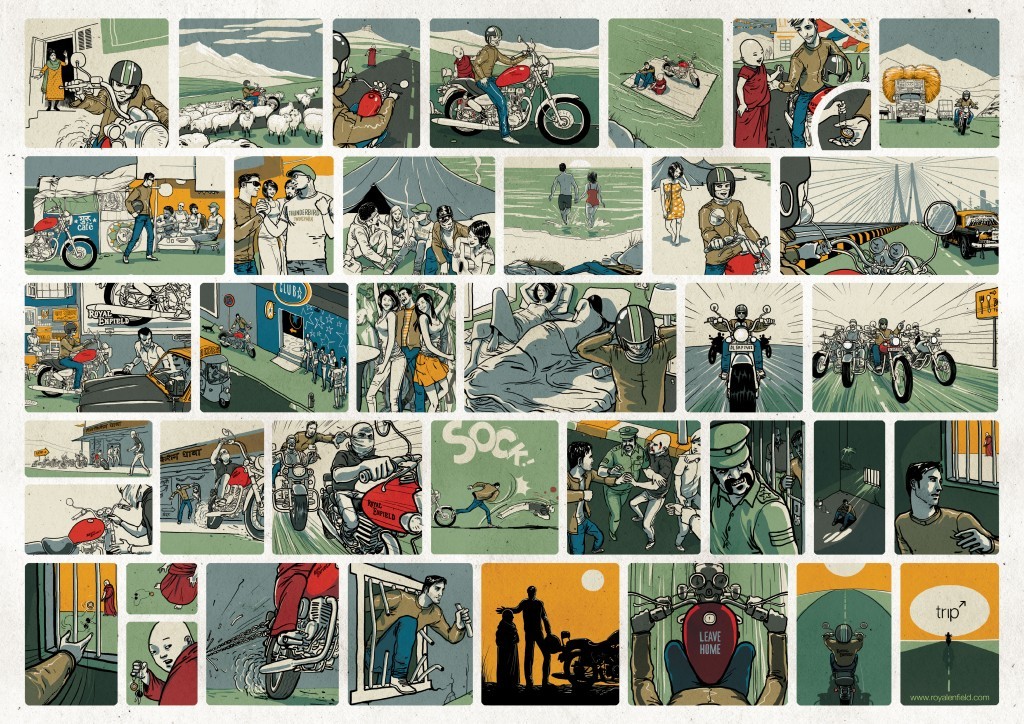
    It’s rare that you come across a press ad that defies expectations. No bold headline, no lengthy paragraphs, no flashy graphics, and not a single word to be found. Not even the most sacred thing—the logo. And it still manages to talk to its audience and tell a story.

    In a world where advertisements often bombard us with words and visuals, this Royal Enfield ad’s silence is its strength. It’s a quiet rebellion against the noise of conventional marketing. This uniqueness draws us in and compels us to decipher its narrative, sparking curiosity and engagement.

    There’s a lesson here about thinking differently. Simply put: when everybody zigs, zag.

    Life can sometimes feel like a crowded highway, with everyone moving in the same direction, following the same route. It’s easy to get caught up in the flow, doing what everyone else is doing, and blending into the background.

    Imagine you’re walking along a well-trodden path, and suddenly you take a sharp turn in a different direction. That’s zagging – going against the grain, choosing the less-traveled path. This principle isn’t just for artists or innovators; it’s a philosophy that anyone can embrace to inject uniqueness into their life’s journey.

    Zagging is about challenging the status quo, questioning norms, and daring to be different. It’s about refusing to be just another sheep in the flock. Instead of following the crowd, you’re forging your own way. This can apply to anything – from trying a new approach to problem-solving at work, to pursuing a hobby that no one around you understands.

    The beauty of zagging is that it opens up new avenues of exploration. When you zig, you’re going where everyone else is headed. But when you zag, you’re carving out your own path, discovering uncharted territory. It’s like taking a detour during a road trip and stumbling upon a hidden gem. By zigging when others zag, you can uncover fresh ideas, find new solutions, and make a lasting impact.

    In a world that often pushes conformity, zagging is a reminder that being different is an asset, not a liability. It’s an invitation to embrace your individuality and stand out from the crowd. So, the next time you find yourself at a crossroads, remember the words: “When everybody zigs, zag.” It might just lead you to exciting new destinations you never thought possible.


  • Quiet please.

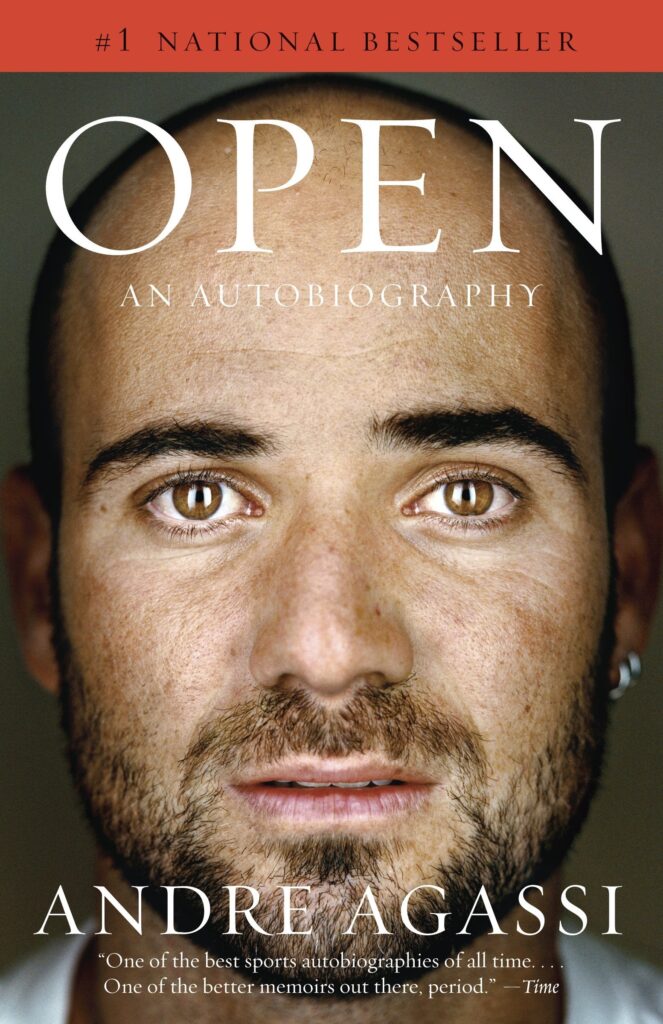
    It’s no accident, I think, that tennis uses the language of life. Advantage, service, fault, break, love, the basic elements of tennis are those of everyday existence, because every match is a life in miniature. Even the structure of tennis, the way the pieces fit inside one another like Russian nesting dolls, mimics the structure of our days. Points become games become sets become tournaments, and it’s all so tightly connected that any point can become the turning point. It reminds me of the way seconds become minutes become hours, and any hour can be our finest. Or darkest. It’s our choice. —Andre Agassi

    In his captivating autobiography Open, tennis legend Andre Agassi serves us more than just a glimpse into his world. He hits the court of life with profound observations that resonate with us all. Agassi beautifully points out that tennis speaks a universal language – one that mirrors the twists and turns of everyday existence. It’s a language of advantage and faults, of breaks and love, much like the ebb and flow of our own lives.

    Agassi’s analogy of tennis to life isn’t just metaphorical; it’s a deep dive into the way every match is like a microcosm of life itself. Just as our days are a series of interconnected moments, every point in a tennis match has the potential to be a turning point. It’s a reminder of how our own choices and actions can sway the course of our journey, be it on the court or in our daily lives.

    The structure of tennis, Agassi points out, resembles the way time unfolds – seconds into minutes into hours. Similarly, points turn into games, which become sets, and eventually build into tournaments. This structure echoes the way every decision we make accumulates, leading us to our personal victories or challenges.

    Agassi’s words aren’t just inspiring; they’re a mirror reflecting the power of choice. Every hour can indeed be our finest or darkest – much like every point in a tennis match. His memoir is a testament to resilience, a journey of self-discovery where triumphs and struggles interweave to create a mosaic of a life lived to its fullest.

    Read it if you haven’t yet. We are planning to read it again 🙂


  • A refreshing take on work-life balance

    Ever felt like the discussion around the topic of work-life balance talk is just a snoozefest? Get ready to be pleasantly surprised. Nigel Marsh’s TED Talk on this very topic is like a breath of fresh air in a room full of stale advice. He dives right into the heart of the matter, and trust us, he’s got a knack for making you giggle before you start scratching your head.

    Nigel Marsh isn’t your typical speaker; he’s like that cool friend who tells it like it is. His TED Talk is a rollercoaster of laughs and “aha” moments. It’s like he’s peeking into your everyday struggles and turning them into comedy gold. You’ll be nodding along, thinking, “Finally, someone gets it!”

    What sets Nigel’s talk apart is its simplicity. He doesn’t bombard you with jargon or complicated strategies. Instead, he takes a down-to-earth approach and shares stories that hit home. From his honest take on juggling work and family to his insights on finding meaning beyond the 9-to-5 grind, Nigel’s words strike a chord.

    He paints a picture of the work-life balance challenge with a dose of reality and a touch of humor. He offers practical tips that don’t require major life overhauls. It’s like he’s passing along life hacks that make you think, “Why didn’t I think of that?”

    Don’t think much. Press play on this TED Talk that’s far from boring. Take our word for it. Nigel Marsh’s wit and wisdom left us with a smile on our faces and a fresh perspective on that elusive work-life balance thing. It was not just another talk; it felt like a journey which left us laughing, reflecting, and rethinking our approach to finding harmony in the chaos. All at the same time 🙂


  • Inspiring design with a punch of humour

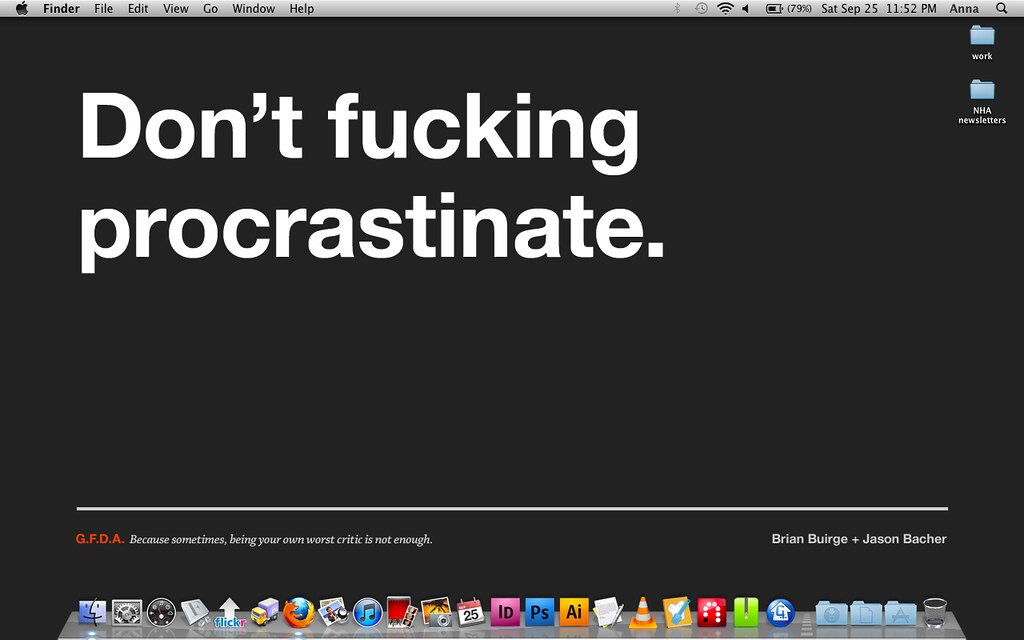
    Don't procrastinate wallpaper by GFDA

    From the moment we stumbled upon GFDA’s set of irreverent advice packaged as wallpapers and posters, we knew we’d found something special. For those who don’t know, GFDA stands for Good Fucking Design Advice 🙂

    It’s like a burst of fresh air in the design world – bold, unapologetic, and full of attitude. GFDA’s take on design advice is like a creative wake-up call, delivered with a healthy dose of humour.

    We’ve come to admire GFDA’s work for its unique blend of wit and design wisdom. Their approach is refreshingly real; they’re not afraid to tell it like it is. Take the “Don’t fucking procrastinate” wallpaper, for instance. It’s not just a catchy phrase; it’s a reminder that creativity thrives when we take action. The combination of straightforward language and clever design makes it a visual motivator that we can’t help but love.

    GFDA’s evolution is a journey we find truly heartening, from their initial quirky site featuring wallpapers and posters to their expanding portfolio of products, workshops, and thought-provoking content today.

    Their philosophy aligns perfectly with ours – creativity is meant to be fun, daring, and unapologetically authentic. Your work should challenge you to break free from the norm and embrace a mindset where design and humour collide. Design doesn’t have to be stuffy or serious; it can be a canvas for self-expression and a catalyst for positive change.

    Keep pushing the boundaries of creativity. Let your work be a daily reminder that design is not just about aesthetics; it’s about breaking barriers, sparking conversations, and leaving a lasting impact that resonates with everyone who encounters it.


  • Information is beautiful: Where data comes to life

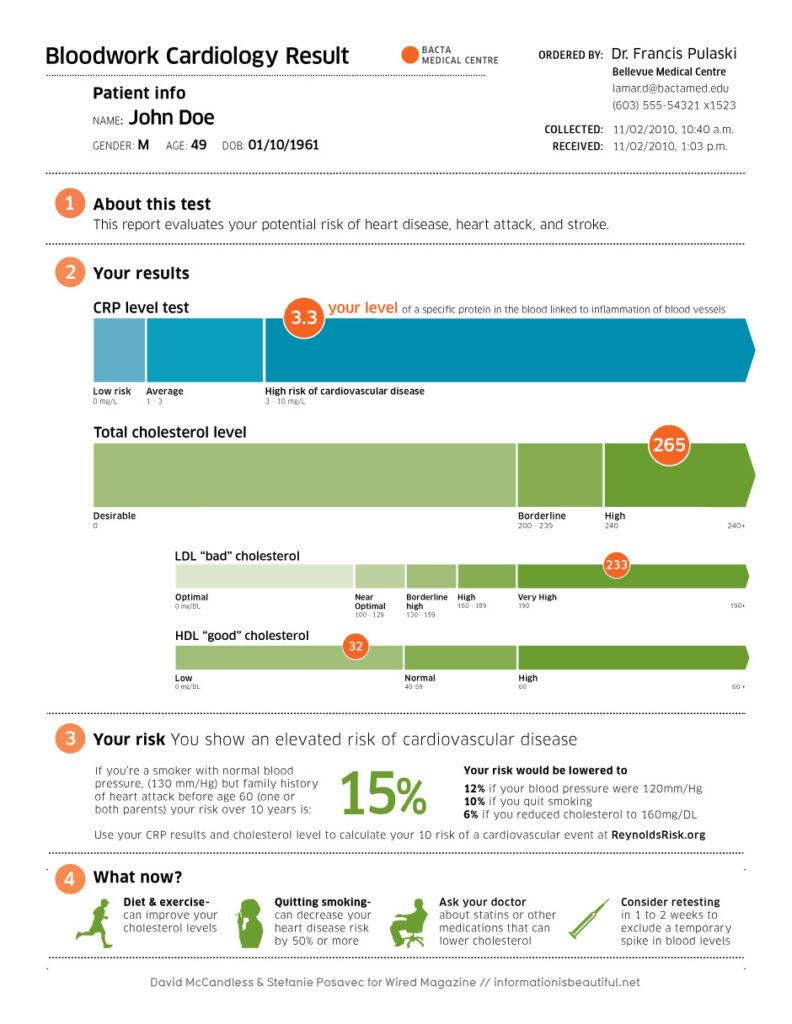
    Blood report design by David McCandless

    Ever thought data could be, well, look cool? Then you’ve got to check out Information is Beautiful. It’s like a magic place where numbers, facts, and info turn into colorful and easy-to-understand pictures. Created by David McCandless, this website takes boring stuff and makes it awesome.

    David and his team are like data superheroes. They take big, confusing information and turn it into eye-catching visuals that anyone can understand. From health facts to global issues, they’ve got it all covered. It’s like learning while having fun – who knew data could be this exciting?

    If you’re curious about the world and love pretty pictures, Information is Beautiful is your go-to. It’s not just a website; it’s a ticket to a world where knowledge meets creativity. So, grab your curiosity and dive into a world where data becomes a work of art.