Category: Ideas


  • The Curious Case of the Hybreed

    Once upon a time in a small agency, this happened. 

    The brainstorming session was over. The CCO turned back to his laptop. Team went back to their desks. A young art director, fairly new to the industry, hung around, leafing through the CCO’s collection of books on the other side of the cabin.

    A while later, the CCO turned around, looked at him for a few seconds, and said.

    “You know, you scare me.”

    To which, the art director replied, “Why, what happened?”

    He responded by saying, “You are an art director who reads. That’s dangerous.”

    And the CCO laughed. The art director wondered why.

    The CCO was from the copy side of things.

    That incident gets me thinking to this day. The common belief goes that there are primarily two breeds in our line of work: Art and Copy.

    But I think there is a third one too. Let’s call it the Hybreed.

    The art person who is adept at copy too. Or the copywriter who has a natural talent in deciding the apt look for her or his ideas.

    It doesn’t stop there. Hybreed has a broad range that goes beyond the standard art-copy combo.

    So it could be a strategist from the design industry who is also very good at designing the perfect identity for a brand design project as well as making cool furniture using wooden planks and plumbing pipes.

    Or the designer from the events industry who also gets the finer nuances of digital plus the ability to experiment with print advertising.

    The combinations are endless.
    Hey, there could very well be a person who has the ability to grasp problems across advertising, marketing, design, business, digital, illustration, animation, typography and what have you. 

    They may not be specialists, or generalists. Hybreeds are beyond these labels. Their focus is always on finding a clear definition of the problem, which would then inform the way ahead. 

    Now the usual way is to find a certain specialist and then let them do their thing, because the project calls for a certain way of thinking and executing. Nothing wrong with that at all.

    Hybreeds don’t challenge that notion. But to completely detach oneself from those parts of the project one is not “great” at is something that they are uncomfortable with. They’d like to know the process, the little details involved, because they believe eventually it will help them solve problems in a better manner.

    As I am writing this, I remember one more incident at a big network agency that someone told me about. There was this guy, definitely a Hybreed. He was good with art, copy, illustration and design. Comics too. The thing is the agency didn’t know what to do with him, since they had no specific title or role for this kind of a guy. And he had difficulty slotting himself into one wherever he applied. I hope he has found his place in the industry, and continues to create awesome stuff.

    Specialists. Yes, they have their place in the world. But what about those people, who have an avid interest in some or all the disciplines that a certain industry offers? Not masters, but not generalists too, because they are curious, and they keep learning, slowly honing their skills whenever they can, and on whatever they can.

    Our industry is all about being a sponge, isn’t it? Absorbing everything that goes around us and then creating magic with it.

    How about absorbing everyone too, especially the Hybreed? Of course, in a way they deserve to be. Don’t feel threatened by them. Celebrate them. And the usual slots probably won’t do. 

    Which brings me back to the first incident. “You’re dangerous.”

    Are they? Really?

    Not from where I’m standing.


  • The thing about ideas

    There are two things for now, that I can think of. One’s great. The other, sad.

    The great thing about ideas is the way they can flap their wings and fly the hell out of the nest that’s inside your head. 

    Yes, you have liberated them from your mind, but I feel that it’s your mind that’s truly liberated. Free. Vacant. Open. Ready to be occupied with at least 10 other ideas to take the place of those who are out there in the big bad world, doing their thing.

    The sad part?

    Well, it is the way we guard them. Like overprotective parents, afraid that someone will take them away from you. Maybe make them their own, and live a good life together that you had planned for them.

    And you don’t even pause for a moment to think that when you do that, they are rotting. Not just your ideas, but your grey cells too.

    What are you scared of? Someone who gets “inspired” from the idea you have released, and say, wins an award? So what?

    What if you don’t have time to think about it, if and when that happens? Why not think from the other side! You will be too busy tinkering with your next batch of ideas. And the next one after that. And the next one.

    Take solace from the fact the people who do that need people like you to be inspired from. And without your lot, they are nothing.

    We are all borrowing from each other, getting inspiration from stuff around us all the time.

    The amazing thing is that the world is always in flux, and you have the ability to always notice something that others would not. And that gives birth to a whole new bunch of ideas, all bubbling with excitement, ready to take off when you allow them to.

    Shouldn’t that be the real victory you savour?


  • India in Icons

    We love icons. Samples from an ongoing series on Noun Project called India in Icons. Download them here. If you want customised icons for your brand, contact us here.


  • Hidden message

    This is a typeface we designed with the basic character set. The experiment was to see how our mind derives meaning from shapes. Where does a shape end, and the language begins? Have you already spotted the hidden message in the image? Too many questions? Ok, we will stop now 🙂


  • How copywriters can change the world

    I learned about cars, robots, food, soap, toys, cigarettes, sweets, fountain pens, timber, fish, newspapers, oil, wine, nuclear fuel, the army, the police. I visited hospitals, refugee hostels, sweet factories, oil refineries and nuclear plants, was taught how to drive a Land Rover through a river, how to fire the cannon of a Centurion tank and have sat quaking in a police car during a high-speed chase. I learned how the insurance and banking systems work, as well as about human rights, our plundered environment and the scandal of places like Bhopal. Through my work l learned about the deep interconnectedness of these things. Society is a web of myriad causes and effects. Tugging at a thread on this side of the web can twitch apparently unrelated strands on the far side. Quite by accident l discovered that the copywriter has real power in the world.

    In case you were wondering, this is Indra Sinha, one of the advertising greats from a powerful article he wrote: How copywriters can change the world.


  • Square Godin

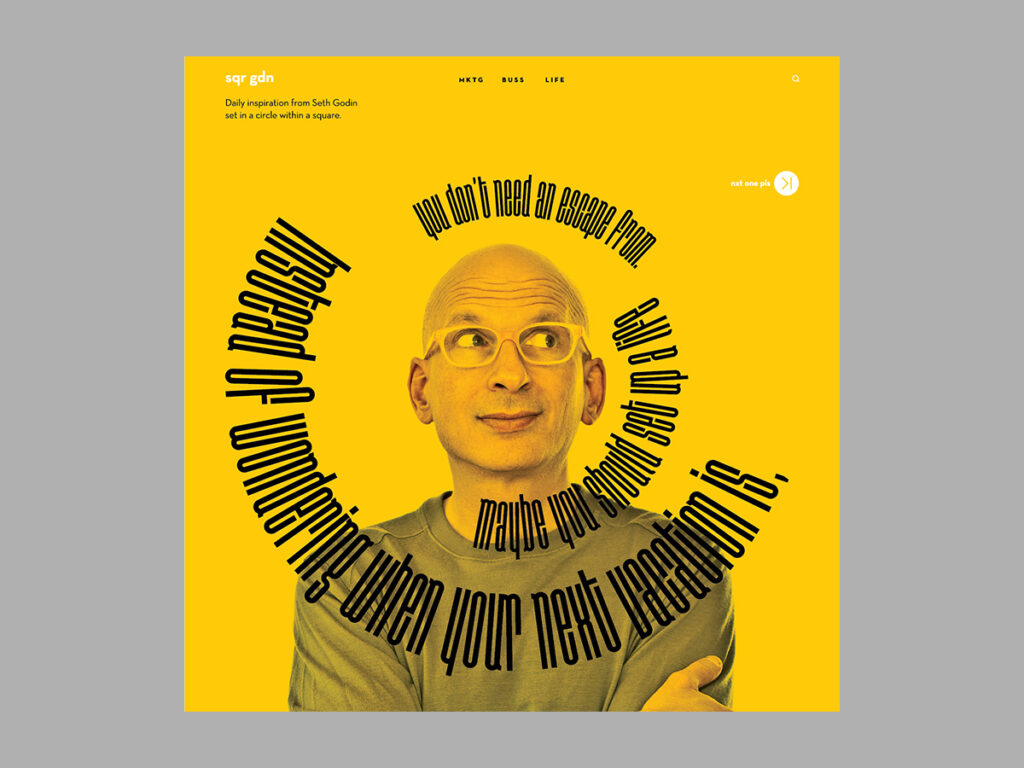
    Have you tried the Square Interface Game yet? Do it, it’s fun. This is our interface design concept, using Seth Godin and his perspectives on business, marketing and life for inspiration.


  • Website made on Instagram

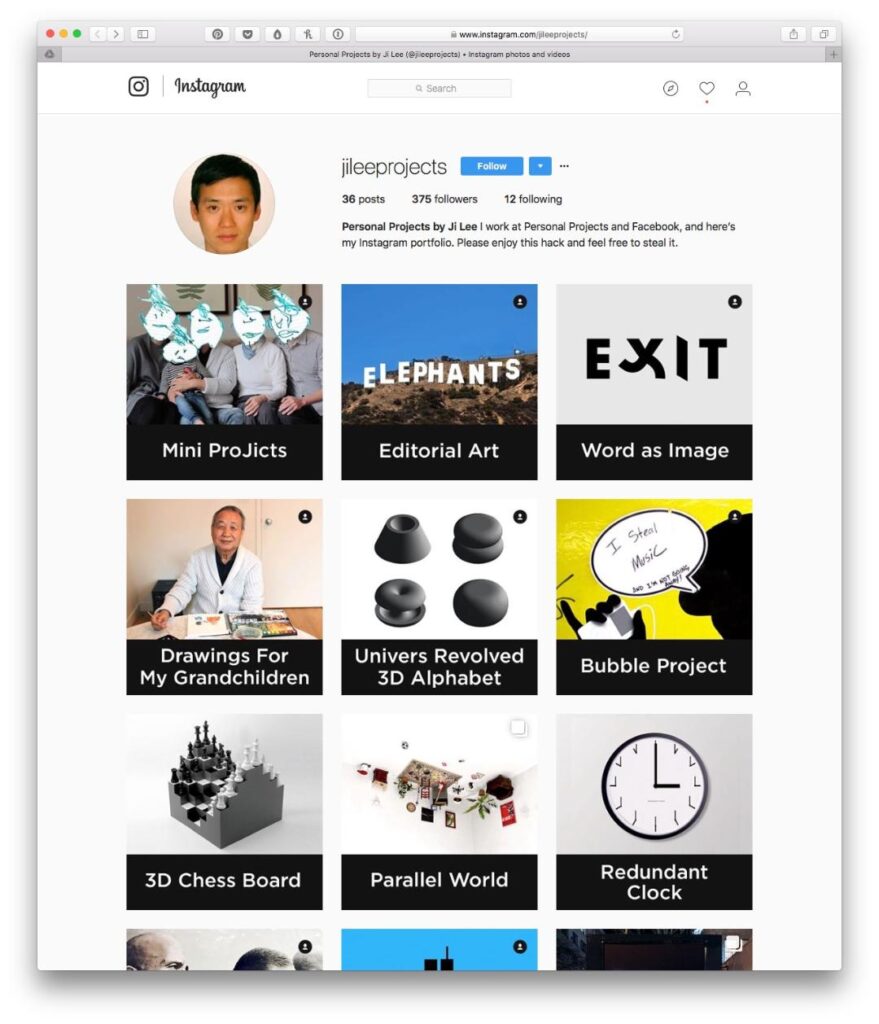
    Using multiple accounts on Instagram, artist Ji Lee built his website and folio. Here is his official website. We like the URL 😀


  • 10 reasons why you should start working with a pen and paper

    We agree with John. Points 6 and 8 are our favs 🙂

    1. Digital is distracting.
    2. Writing by hand stimulates your brain.
    3. Writing and drawing by hand slows you down in a good way.
    4. Writing by hand enhances learning.
    5. When you write by hand you actually produce more ideas.
    6. Scribbling is fun.
    7. Writing by hand makes you smarter.
    8. Paper doesn’t have a “delete” button.
    9. It is easy to fall into patterns in digital.
    10. The greatest advertising campaigns in history were created that way.


  • Very important questions

    John Maeda has noted two Georges’ way of thinking about problems in their respective fields–Mathematics and Research. We see both these sets of questions fitting perfectly with marketing, business and life too.

    George Pólya’s questions for problem solving in mathematics:

    Understand the problem
    • What is the unknown?
    • What are the data?
    • What is the condition?
    • Can the problem be solved?

    Assumptions
    • What can you or need you assume?
    • What shouldn’t you assume?
    • Have you made subconscious assumptions?

    Devising a plan of attack
    • Have you seen this or a related problem before?
    • Have you seen a similar unknown before?
    • Can you restate the problem?
    • If you can’t solve this problem, can you solve a similar or simpler problem?

    Aftermath
    • Are you sure of the solution? Can you see it at a glance?
    • Did you use all the data? the whole condition?
    • Can you get the same solution another way?
    • Are there other valid solutions?
    • Can you apply the solution or method to another problem?
    • Was this a satisfying problem to solve?

    .

    George Heilmeier’s list of questions for solving research challenges:

    1. What are you trying to do? Articulate your objectives using absolutely no jargon.
    2. How is it done today, and what are the limits of current practice?
    3. What is new in your approach and why do you think it will be successful?
    4. Who cares? If you are successful, what difference will it make?
    5. What are the risks?
    6. How much will it cost?
    7. How long will it take?
    8. What are the mid-term and final “exams” to check for success?

  • Wordplay

    I love language and I love ideas that are simple. Simple ideas communicate in a simpler way.

    —Dean Poole

    A heads-up: This video is 34 minutes long. But all kinds of fun, if you are into language, play and creativity. Read more about the talk and Dean Poole here.