A curated collection of creative things and interesting thoughts. Some of it, ours. The rest, collected carefully from the online and offline worlds. Published in public interest by Jokar. Read more about the blog here.
More than the HP, Titan and the Kissan logos, my ever-lasting memory of Sudarshan Dheer is munching channa in his office.
Besides art and typography, his favourite topics (in no particular order) were: the philosophy of Jiddu Krishnamurti; who designed the first shoelace?; why most clocks are round? He said, “Is it because the planet is round? Or is it because time has a circular continuous concept?”
And then it was time to step out for lunch. There were five options in Colaba: the Sea Lounge (whiskey sours and bumping into Dom Moraes by the window), Paradise (scotch broth and raspberry drink), Martins (beef and more beef), Kailash Parbat (chaat and dal pakwan).
“This is India,” he said, “When will our designs be able to reflect this?”
In case you were wondering, this was from a conversation between Sudarshan Dheer and Ramu Ramanathan. It’s an insightful article on Campaign India.
Once upon a time in a small agency, this happened.
The brainstorming session was over. The CCO turned back to his laptop. Team went back to their desks. A young art director, fairly new to the industry, hung around, leafing through the CCO’s collection of books on the other side of the cabin.
A while later, the CCO turned around, looked at him for a few seconds, and said.
“You know, you scare me.”
To which, the art director replied, “Why, what happened?”
He responded by saying, “You are an art director who reads. That’s dangerous.”
And the CCO laughed. The art director wondered why.
The CCO was from the copy side of things.
That incident gets me thinking to this day. The common belief goes that there are primarily two breeds in our line of work: Art and Copy.
But I think there is a third one too. Let’s call it the Hybreed.
The art person who is adept at copy too. Or the copywriter who has a natural talent in deciding the apt look for her or his ideas.
It doesn’t stop there. Hybreed has a broad range that goes beyond the standard art-copy combo.
So it could be a strategist from the design industry who is also very good at designing the perfect identity for a brand design project as well as making cool furniture using wooden planks and plumbing pipes.
Or the designer from the events industry who also gets the finer nuances of digital plus the ability to experiment with print advertising.
The combinations are endless.
Hey, there could very well be a person who has the ability to grasp problems across advertising, marketing, design, business, digital, illustration, animation, typography and what have you.
They may not be specialists, or generalists. Hybreeds are beyond these labels. Their focus is always on finding a clear definition of the problem, which would then inform the way ahead.
Now the usual way is to find a certain specialist and then let them do their thing, because the project calls for a certain way of thinking and executing. Nothing wrong with that at all.
Hybreeds don’t challenge that notion. But to completely detach oneself from those parts of the project one is not “great” at is something that they are uncomfortable with. They’d like to know the process, the little details involved, because they believe eventually it will help them solve problems in a better manner.
As I am writing this, I remember one more incident at a big network agency that someone told me about. There was this guy, definitely a Hybreed. He was good with art, copy, illustration and design. Comics too. The thing is the agency didn’t know what to do with him, since they had no specific title or role for this kind of a guy. And he had difficulty slotting himself into one wherever he applied. I hope he has found his place in the industry, and continues to create awesome stuff.
Specialists. Yes, they have their place in the world. But what about those people, who have an avid interest in some or all the disciplines that a certain industry offers? Not masters, but not generalists too, because they are curious, and they keep learning, slowly honing their skills whenever they can, and on whatever they can.
Our industry is all about being a sponge, isn’t it? Absorbing everything that goes around us and then creating magic with it.
How about absorbing everyone too, especially the Hybreed? Of course, in a way they deserve to be. Don’t feel threatened by them. Celebrate them. And the usual slots probably won’t do.
Which brings me back to the first incident. “You’re dangerous.”
We love icons. Samples from an ongoing series on Noun Project called India in Icons. Download them here. If you want customised icons for your brand, contact us here.
This is a typeface we designed with the basic character set. The experiment was to see how our mind derives meaning from shapes. Where does a shape end, and the language begins? Have you already spotted the hidden message in the image? Too many questions? Ok, we will stop now 🙂
Everyone always talks about confidence in believing what you do. I remember once going to a class in yoga where the teacher said that, spirituality speaking, if you believed that you had achieved enlightenment you have merely arrived at your limitation. I think that is also true in a practical sense. Deeply held beliefs of any kind prevent you from being open to experience, which is why I find all firmly held ideological positions questionable. It makes me nervous when someone believes too deeply or too much. I think that being skeptical and questioning all deeply held beliefs is essential. Of course we must know the difference between skepticism and cynicism because cynicism is as much a restriction of one’s openness to the world as passionate belief is.
In case you were wondering, this was by the man who led Milton Glaser Inc. in one of his many enlightening essays on his website.
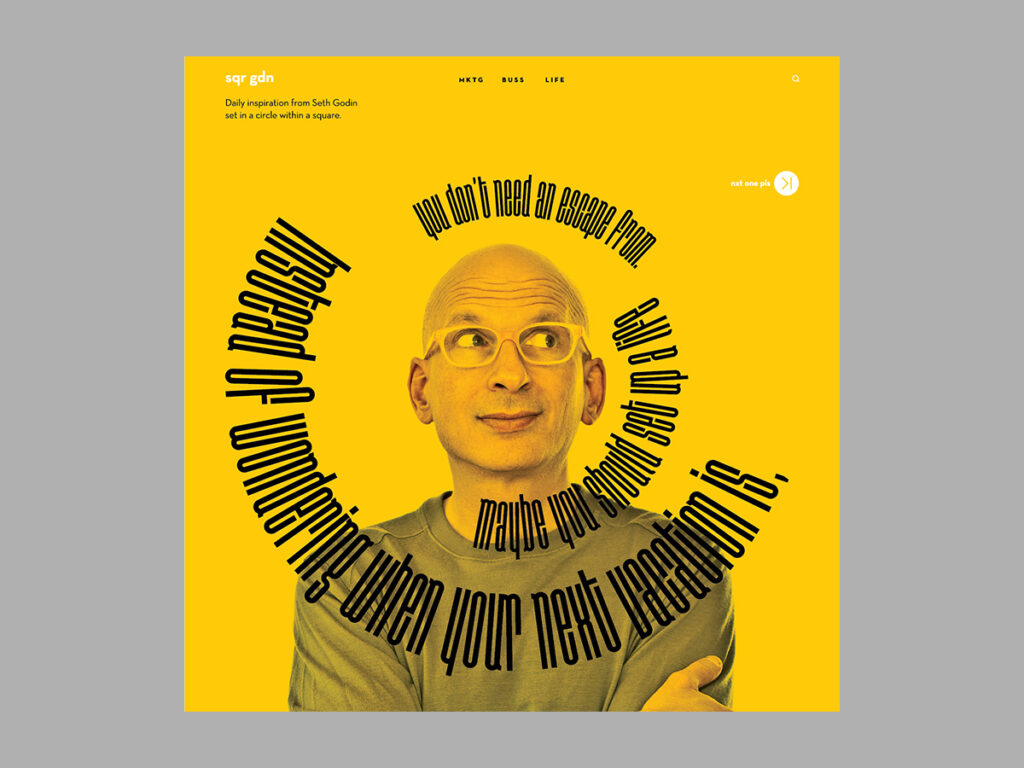
Have you tried the Square Interface Game yet? Do it, it’s fun. This is our interface design concept, using Seth Godin and his perspectives on business, marketing and life for inspiration.
One of the most interesting parts of his story is that he now looks back on his career with some regret. “If I had to do it over again, I would not want to be a designer,” he’s said. “There are too many unnecessary products in this world.” He has long been an advocate for the ideas of environmental consciousness and long-lasting products. He’s dismayed by today’s unsustainable world of over-consumption, where “design” has been reduced to a meaningless marketing buzzword.
In case you were wondering, this is Dieter Rams talking about product design and consumerism in Rams, a documentary by Gary Hustwit.
The grid system is an aid, not a guarantee. It permits a number of possible uses and each designer can look for a solution appropriate to his personal style. But one must learn how to use the grid; it is an art that requires practice.
—Josef Müller-Brockmann
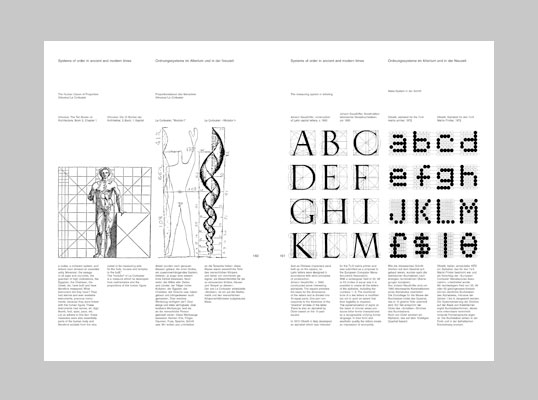
From a professional for professionals, here is the definitive word on using grid systems in graphic design. Though Muller-Brockman first presented hi interpretation of grid in 1961, this text is still useful today for anyone working in the latest computer-assisted design. With examples on how to work correctly at a conceptual level and exact instructions for using all of the systems (8 to 32 fields), this guidebook provides a crystal-clear framework for problem-solving.
The go-to book for grid-based graphic design. Special mention: pages 129-144 show you how to use it for exhibitions.
Suzanne LaBarre gives Dieter Rams’s design principles a 21st century upgrade in this article on Fast Company. We consider principles 7 and 8 in particular to be very relevant.
One. GOOD DESIGN IS TRANSPARENT User-friendly design has been the dominant paradigm in human-computer interaction for decades, and for good reason: It reduces complex code into a simple language anyone can understand. But today, amid a string of high-profile data breaches and opaque algorithms that threaten the very bedrock of democracy, consumers have grown wary of slick interfaces that hide their inner workings. “For years there was such a huge UX trend toward seamlessness and concealing as much as possible in the interest of making things user-friendly,” Ame Elliott, design director of the nonprofit Simply Secure, said last year. “Now, as discipline, interaction designers and UX experts have a lot of hard work to do to think about how to expose those seams in appropriate ways.” Good design should be transparent enough to empower users–to help them make informed decisions about their privacy, their browsing habits, and more–without overwhelming them.
Two. GOOD DESIGN CONSIDERS BROAD CONSEQUENCES Another problem with user-friendly design: In focusing on the immediate needs of users, it often fails to consider long-term consequences. Take Facebook’s echo chamber, Airbnb’s deleterious impact on affordable housing, or the smartphone, which is literally changing people’s brains and has spawned an entire generation of teenage automatons. Good design chases more than clicks. It’s mindful of potential impact–whether economic, social, cultural, or environmental–and it’s mindful of that impact over time. There’s one simple test, according to Rob Girling and Emilia Palaveeva of the design consultancy Artefact: “Don’t just ask ‘how might we?’” they write, invoking a common term of art in design thinking. “Ask, ‘At what cost?’”
Three. GOOD DESIGN IS SLOW For the past 20 years, tech has embraced a “move fast and break things” mantra. That was fine when software had a relatively small impact on the world. But today, it shapes nearly every aspect of our lives, from what we read to whom we date to how we spend money–and it’s largely optimized to benefit corporations, not users. The stakes have changed, the methods haven’t. Good design takes time. It favors long-term solutions over quick fixes. As Basecamp designer Jonas Downey puts it: “Now it’s time to slow down and take stock of what’s broken.”
Four. GOOD DESIGN IS HONEST This is one of Rams’s tenets, but it bears repeating at a time when dark patterns abound and corporations treat UX like a weapon. Uber is the most flagrant example. The company built its business on a seamless front-end user experience (hail a ride, without ever pulling out your wallet!) while playing puppet master with both users and drivers. The company’s fall from grace–culminating in CEO Travis Kalanick’s ousting last year–underscores the shortsightedness of this approach. Good design “does not make a product more innovative, powerful or valuable than it really is,” Rams writes. “It does not attempt to manipulate the consumer with promises that cannot be kept.”
Five. GOOD DESIGN IS POLITICAL “If you work in software or design… you also work in politics.” That was British designer Richard Pope writing at the end of 2016 after the surprise election of Donald Trump, but the point remains relevant more than a year later: Politics is about the distribution of power, and few things distribute power more broadly and rapidly in the 21st century than code and design. Facebook’s role in shaping the outcome of the presidential election is one obvious example. But you can find subtler examples all over the place, from ads targeting men for higher paying jobs to predictive policing software that indicts black people more than white people. Good design is upfront about its potential to shape the political landscape.
Six. GOOD DESIGN IS MINDFUL OF SYSTEMS Systems thinking is a lofty term for a relatively simple idea: Everything is connected, and designers and developers should strategize accordingly. Systems thinking has taken on even greater import over the past few years, as the world becomes more complex and intertwined. Consider that we generate 2.5 quintillion bytes of data a year, more than 90% of which was created in just the past two years. Today, nearly half of all adults own a smartphone; by 2020, that figure is expected to climb to 80%. Good design, then, is no longer about solving discrete problems: It’s about considering the sum of the parts. “The challenge is to rise above the distraction of the details and widen your field of vision,” writes Foundation Capital partner Steve Vassallo. “Try to see the whole world at once and make sense of it. It’s a heady challenge, but you either design the system or you get designed by the system.”
Seven. GOOD DESIGN IS GOOD WRITING In his “2017 Design in Tech Report,” author John Maeda anointed writing as design’s newest unicorn skill. It’s easy to see why. With the rise of chatbots and conversational UI, writing is often the primary interface through which users interact with a product or service. (Siri’s dad jokes had to be written by someone.) But even designers who don’t work on interface copy should be able to articulate themselves clearly. The better their writing, the better their chances of selling an idea.
Eight. GOOD DESIGN IS MULTIFACETED The days of brands peddling a single identity are gone. The Emotional Intelligence Agency, a U.K.-based branding firm, analyzed the brands that more than 5,000 people said they sought out. The results were surprisingly consistent. Top brands, from Victoria’s Secret to Taco Bell, had four seemingly disparate traits: humor, usefulness, beauty, and inspiration. The takeaway? In an increasingly complex retail landscape, brands must adopt multifaceted personalities to connect emotionally with consumers.
Nine. GOOD DESIGN TAKES RISKS Ideo studied more than 100 companies in an attempt to quantify innovation and came away with six key insights. Among them? Challenging the status quo has real business benefits. According to the study, chances of a failed product launch decreased by 16.67% when people felt comfortable acting with autonomy.
Ten. GOOD DESIGN IS FOR PEOPLE—AND MACHINES Historically, computers have been designed for human users. But as machines grow smarter and artificial intelligence takes root in people’s daily lives, designers will have to build for a new type of user: the human-machine hybrid. So suggests Normative CEO Matthew Milan, who argues that hybrids can do more than any person or computer could accomplish alone, like navigate traffic or compete in superpowered chess games. Looking ahead, good design will help people trust a system–even when they know they don’t have much agency within it.