Category: Articles


  • 10 new principles of good design

    Suzanne LaBarre gives Dieter Rams’s design principles a 21st century upgrade in this article on Fast Company. We consider principles 7 and 8 in particular to be very relevant.

    One. GOOD DESIGN IS TRANSPARENT
    User-friendly design has been the dominant paradigm in human-computer interaction for decades, and for good reason: It reduces complex code into a simple language anyone can understand. But today, amid a string of high-profile data breaches and opaque algorithms that threaten the very bedrock of democracy, consumers have grown wary of slick interfaces that hide their inner workings. “For years there was such a huge UX trend toward seamlessness and concealing as much as possible in the interest of making things user-friendly,” Ame Elliott, design director of the nonprofit Simply Secure, said last year. “Now, as discipline, interaction designers and UX experts have a lot of hard work to do to think about how to expose those seams in appropriate ways.” Good design should be transparent enough to empower users–to help them make informed decisions about their privacy, their browsing habits, and more–without overwhelming them.


    Two. GOOD DESIGN CONSIDERS BROAD CONSEQUENCES
    Another problem with user-friendly design: In focusing on the immediate needs of users, it often fails to consider long-term consequences. Take Facebook’s echo chamber, Airbnb’s deleterious impact on affordable housing, or the smartphone, which is literally changing people’s brains and has spawned an entire generation of teenage automatons.
    Good design chases more than clicks. It’s mindful of potential impact–whether economic, social, cultural, or environmental–and it’s mindful of that impact over time. There’s one simple test, according to Rob Girling and Emilia Palaveeva of the design consultancy Artefact: “Don’t just ask ‘how might we?’” they write, invoking a common term of art in design thinking. “Ask, ‘At what cost?’”


    Three. GOOD DESIGN IS SLOW
    For the past 20 years, tech has embraced a “move fast and break things” mantra. That was fine when software had a relatively small impact on the world. But today, it shapes nearly every aspect of our lives, from what we read to whom we date to how we spend money–and it’s largely optimized to benefit corporations, not users. The stakes have changed, the methods haven’t. Good design takes time. It favors long-term solutions over quick fixes. As Basecamp designer Jonas Downey puts it: “Now it’s time to slow down and take stock of what’s broken.”


    Four. GOOD DESIGN IS HONEST
    This is one of Rams’s tenets, but it bears repeating at a time when dark patterns abound and corporations treat UX like a weapon. Uber is the most flagrant example. The company built its business on a seamless front-end user experience (hail a ride, without ever pulling out your wallet!) while playing puppet master with both users and drivers. The company’s fall from grace–culminating in CEO Travis Kalanick’s ousting last year–underscores the shortsightedness of this approach.
    Good design “does not make a product more innovative, powerful or valuable than it really is,” Rams writes. “It does not attempt to manipulate the consumer with promises that cannot be kept.”


    Five. GOOD DESIGN IS POLITICAL
    “If you work in software or design… you also work in politics.” That was British designer Richard Pope writing at the end of 2016 after the surprise election of Donald Trump, but the point remains relevant more than a year later: Politics is about the distribution of power, and few things distribute power more broadly and rapidly in the 21st century than code and design. Facebook’s role in shaping the outcome of the presidential election is one obvious example. But you can find subtler examples all over the place, from ads targeting men for higher paying jobs to predictive policing software that indicts black people more than white people.
    Good design is upfront about its potential to shape the political landscape.


    Six. GOOD DESIGN IS MINDFUL OF SYSTEMS
    Systems thinking is a lofty term for a relatively simple idea: Everything is connected, and designers and developers should strategize accordingly.  Systems thinking has taken on even greater import over the past few years, as the world becomes more complex and intertwined. Consider that we generate 2.5 quintillion bytes of data a year, more than 90% of which was created in just the past two years. Today, nearly half of all adults own a smartphone; by 2020, that figure is expected to climb to 80%.
    Good design, then, is no longer about solving discrete problems: It’s about considering the sum of the parts. “The challenge is to rise above the distraction of the details and widen your field of vision,” writes Foundation Capital partner Steve Vassallo. “Try to see the whole world at once and make sense of it. It’s a heady challenge, but you either design the system or you get designed by the system.”


    Seven. GOOD DESIGN IS GOOD WRITING
    In his “2017 Design in Tech Report,” author John Maeda anointed writing as design’s newest unicorn skill. It’s easy to see why. With the rise of chatbots and conversational UI, writing is often the primary interface through which users interact with a product or service. (Siri’s dad jokes had to be written by someone.) But even designers who don’t work on interface copy should be able to articulate themselves clearly. The better their writing, the better their chances of selling an idea.


    Eight. GOOD DESIGN IS MULTIFACETED
    The days of brands peddling a single identity are gone. The Emotional Intelligence Agency, a U.K.-based branding firm, analyzed the brands that more than 5,000 people said they sought out. The results were surprisingly consistent. Top brands, from Victoria’s Secret to Taco Bell, had four seemingly disparate traits: humor, usefulness, beauty, and inspiration. The takeaway? In an increasingly complex retail landscape, brands must adopt multifaceted personalities to connect emotionally with consumers.


    Nine. GOOD DESIGN TAKES RISKS
    Ideo studied more than 100 companies in an attempt to quantify innovation and came away with six key insights. Among them? Challenging the status quo has real business benefits. According to the study, chances of a failed product launch decreased by 16.67% when people felt comfortable acting with autonomy.


    Ten. GOOD DESIGN IS FOR PEOPLE—AND MACHINES
    Historically, computers have been designed for human users. But as machines grow smarter and artificial intelligence takes root in people’s daily lives, designers will have to build for a new type of user: the human-machine hybrid. So suggests Normative CEO Matthew Milan, who argues that hybrids can do more than any person or computer could accomplish alone, like navigate traffic or compete in superpowered chess games.
    Looking ahead, good design will help people trust a system–even when they know they don’t have much agency within it.


  • 25 tips to become a better writer

    1. PD James: On just sitting down and doing it…
      Don’t just plan to write—write. It is only by writing, not dreaming about it, that we develop our own style.
    2. Steven Pressfield: On starting before you’re ready…
      [The] Resistance knows that the longer we noodle around “getting ready,” the more time and opportunity we’ll have to sabotage ourselves. Resistance loves it when we hesitate, when we over-prepare. The answer: plunge in.
    3. Esther Freud: On finding your routine…
      Find your best time of the day for writing and write. Don’t let anything else interfere. Afterwards it won’t matter to you that the kitchen is a mess.
    4. Zadie Smith: On unplugging…
      Work on a computer that is disconnected from the internet.
    5. Kurt Vonnegut: On finding a subject…
      Find a subject you care about and which you in your heart feel others should care about. It is this genuine caring, and not your games with language, which will be the most compelling and seductive element in your style. I am not urging you to write a novel, by the way — although I would not be sorry if you wrote one, provided you genuinely cared about something. A petition to the mayor about a pothole in front of your house or a love letter to the girl next door will do.
    6. Maryn McKenna: On keeping your thoughts organized…
      Find an organizational scheme for your notes and materials; keep up with it (if you are transcribing sound files or notebooks, don’t let yourself fall behind); and be faithful to it: Don’t obsess over an apparently better scheme that someone else has. At some point during your work, someone will release what looks like a brilliant piece of software that will solve all your problems. Resist the urge to try it out, whatever it is, unless 1) it is endorsed by people whose working methods you already know to be like your own and 2) you know you can implement it quickly and easily without a lot of backfilling. Reworking organizational schemes is incredibly seductive and a massive timesuck.
    7. Bill Wasik: On the importance of having an outline…
      Hone your outline and then cling to it as a lifeline. You can adjust it in mid-stream, but don’t try to just write your way into a better structure: think about the right structure and then write to it. Your outline will get you through those periods when you can’t possibly imagine ever finishing the damn thing — at those times, your outline will let you see it as a sequence of manageable 1,000 word sections.
    8. Joshua Wolf Shenk: On getting through that first draft…
      Get through a draft as quickly as possible. Hard to know the shape of the thing until you have a draft. Literally, when I wrote the last page of my first draft of “Lincoln’s Melancholy” I thought, Oh, shit, now I get the shape of this. But I had wasted years, literally years, writing and re-writing the first third to first half. The old writer’s rule applies: Have the courage to write badly.
    9. Sarah Waters: On being disciplined…
      Treat writing as a job. Be disciplined. Lots of writers get a bit OCD-ish about this. Graham Greene famously wrote 500 words a day. Jean Plaidy managed 5,000 before lunch, then spent the afternoon answering fan mail. My minimum is 1,000 words a day – which is sometimes easy to achieve, and is sometimes, frankly, like shitting a brick, but I will make myself stay at my desk until I’ve got there, because I know that by doing that I am inching the book forward. Those 1,000 words might well be rubbish – they often are. But then, it is always easier to return to rubbish words at a later date and make them better.
    10. Jennifer Egan: On being willing to write badly…
      [Be] willing to write really badly. It won’t hurt you to do that. I think there is this fear of writing badly, something primal about it, like: “This bad stuff is coming out of me…” Forget it! Let it float away and the good stuff follows. For me, the bad beginning is just something to build on. It’s no big deal. You have to give yourself permission to do that because you can’t expect to write regularly and always write well. That’s when people get into the habit of waiting for the good moments, and that is where I think writer’s block comes from. Like: It’s not happening. Well, maybe good writing isn’t happening, but let some bad writing happen… When I was writing “The Keep,” my writing was so terrible. It was God-awful. My working title for that first draft was, A Short Bad Novel. I thought: “How can I disappoint?”
    11. AL Kennedy: On fear…
      Be without fear. This is impossible, but let the small fears drive your rewriting and set aside the large ones until they behave – then use them, maybe even write them. Too much fear and all you’ll get is silence.
    12. Will Self: On not looking back…
      Don’t look back until you’ve written an entire draft, just begin each day from the last sentence you wrote the preceeding day. This prevents those cringing feelings, and means that you have a substantial body of work before you get down to the real work which is all in… The edit.
    13. Haruki Murakami: On building up your ability to concentrate…
      In private correspondence the great mystery writer Raymond Chandler once confessed that even if he didn’t write anything, he made sure he sat down at his desk every single day and concentrated. I understand the purpose behind his doing this. This is the way Chandler gave himself the physical stamina a professional writer needs, quietly strengthening his willpower. This sort of daily training was indispensable to him.
    14. Geoff Dyer: On the power of multiple projects…
      Have more than one idea on the go at any one time. If it’s a choice between writing a book and doing nothing I will always choose the latter. It’s only if I have an idea for two books that I choose one rather than the other. I always have to feel that I’m bunking off from something.
    15. Augusten Burroughs: On who to hang out with…
      Don’t hang around with people who are negative and who are not supportive of your writing. Make friends with writers so that you have a community. Hopefully, your community of writer friends will be good and they’ll give you good feedback and good criticism on your writing but really the best way to be a writer is to be a writer.
    16. Neil Gaiman: On feedback…
      When people tell you something’s wrong or doesn’t work for them, they are almost always right. When they tell you exactly what they think is wrong and how to fix it, they are almost always wrong.
    17. Margaret Atwood: On second readers…
      You can never read your own book with the innocent anticipation that comes with that first delicious page of a new book, because you wrote the thing. You’ve been backstage. You’ve seen how the rabbits were smuggled into the hat. Therefore ask a reading friend or two to look at it before you give it to anyone in the publishing business. This friend should not be someone with whom you have a romantic relationship, unless you want to break up.
    18. Richard Ford: On others’ fame and success…
      Try to think of others’ good luck as encouragement to yourself.
    19. Helen Dunmore: On when to stop…
      Finish the day’s writing when you still want to continue.
    20. Hilary Mantel: On getting stuck…
      If you get stuck, get away from your desk. Take a walk, take a bath, go to sleep, make a pie, draw, listen to music, meditate, exercise; whatever you do, don’t just stick there scowling at the problem. But don’t make telephone calls or go to a party; if you do, other people’s words will pour in where your lost words should be. Open a gap for them, create a space. Be patient.
    21. Annie Dillard: On things getting out of control…
      A work in progress quickly becomes feral. It reverts to a wild state overnight… it is a lion growing in strength. You must visit it every day and reassert your mastery over it. If you skip a day, you are, quite rightly, afraid to open the door to its room. You enter its room with bravura, holding a chair at the thing and shouting, ‘Simba!’
    22. Cory Doctorow: On writing when the going gets tough…
      Write even when the world is chaotic. You don’t need a cigarette, silence, music, a comfortable chair, or inner peace to write. You just need ten minutes and a writing implement.
    23. Chinua Achebe: On doing all that you can…
      I believe myself that a good writer doesn’t really need to be told anything except to keep at it. Just think of the work you’ve set yourself to do, and do it as well as you can. Once you have really done all you can, then you can show it to people. But I find this is increasingly not the case with the younger people. They do a first draft and want somebody to finish it off for them with good advice. So I just maneuver myself out of this. I say, Keep at it. I grew up recognizing that there was nobody to give me any advice and that you do your best and if it’s not good enough, someday you will come to terms with that.
    24. Joyce Carol Oates: On persevering…
      I have forced myself to begin writing when I’ve been utterly exhausted, when I’ve felt my soul as thin as a playing card, when nothing has seemed worth enduring for another five minutes… and somehow the activity of writing changes everything. Or appears to do so.
    25. Anne Enright: On why none of this advice really matters…
      The way to write a book is to actually write a book. A pen is useful, typing is also good. Keep putting words on the page.

    Via The 99 Percent.


  • The book list you must read

    Even a book list by Neil French is fun to read.

    BOOKS (Updated 1/2/08) 

    In my experience, people in my business frequently enjoy the same books, films, and music. Since I’m often asked about my favourites, here are some books: (Films and music used to be on here, under different buttons on the web-site. Research showed that nobody cared enough for me to bother updating them, and frankly, they don’t vary as much as my book-preferences, so I’ve deleted them)

    I read a hell of a lot. I’ve excluded obvious classics, like Dickens, Kipling, Dostoevsky, A.A.Milne, Conrad and so on. These below are more current, and may never even become classics…but I’d hate you to miss them. 
    Incidentally, I’ve put books I really dislike in red, like that. Don’t want you to think I’d actually recommended them!

    Bold italics means “do not miss this one” 
    Underlined Bold Italics means “do not miss this one or your entire life will have been pointless”.

    BOOKS I’M CURRENTLY READING, or have just read…or which are on the bedside table.

    Lost WorldsMichael Bywater. I’ve read everything I can by this bloke, ever since he was a dyspeptic ranter on the now-defunct ‘Punch’ magazine. He now writes regularly in The Independent. This is, I guess, placeable in the Grumpy Old Men genre, but actually it’s MUCH more important than that. If you’re over forty and English, you have to read it. If you’re over sixty, it’s the story of your life. His latest, ‘Big Babies’ has a horrid cover-design, but is, if anything, even more grumpy. I LOVED it!

    Pontoon. Garrison Keillor. I was reminded how much I liked his work when I recognised his as the voice-over on the rightly award-winning Honda series of commercials (in itself an inspired choice). My recommendation, though, is first to buy one of the original audio-books, which feature a selection of his radio talks called ‘The Prairie Home Companion’. If you like those, you’ll adore his books.

    The Good Husband of Zebra Drive. Alexander McCall Smith. The adventures of Mrs. Ramotswe, proprietor of the No.1 Ladies Detective Agency in Botswana are addictive. This is the latest. Full of gentle humour and lots of humanity, they are the perfect antidote to ‘civilisation’. Get them all. No sex, no violence, not much tragedy, and a simple joy to read. (Oddly enough, I can’t get along with any of his other efforts. Mrs. Ramotswe rules).

    Shakespeare. Bill Bryson. Sheer delight. Everything you ever wanted to know about William S., deftly researched, and written by a very funny man who doesn’t try too hard to be so. Even if you’re not a Bard-fan, you could enjoy this.

    The Uncommon Reader. Alan Bennett. The Queen discovers that the traveling library stops at the staff entrance of Buck House. Unwittingly, almost, she begins to read (having avoided it for sixty years). The story starts here and is a joy! The denouement is brilliant. I love Alan Bennett, and play his readings and plays on my iPod and in the car. It might be worth getting the audio-book of this, just for his delivery.

    The Generals. Simon Scarrow. See below.

    Imperium. Robert Harris. Skullduggery in Ancient Rome. Just a great read, as I now realise have been all his books, starting with the Hannibal the Cannibal series. I think he deserves to be in the favourite writers section actually.

    This is just the tip of the iceberg. Want to read the whole thing? Go here.


  • Good filmmaking lessons

    1. The learning was about interpreting a written concept and transferring it with the right feel onto film media. Filmmaking can either embellish an idea, or make you lose the idea completely.
    2. I also can’t forget what Piyush Pandey once told me: “You must disappear as a director from this project.” Every artiste has an urge to prove himself, an urge for showmanship. A great performance comes through not as an actor, but when he is the character. I learnt from him that it is vital to let your content do the talking.
    3. That Nirma Underwater Ballet film project with TapRoot taught me to always try something you think you cannot do. The dancers had to dance and come into the right position under water. It was a virtual nightmare and almost didn’t work.
    4. Satyajit Ray had this rule of sorts that everyone on the set should return with something that they learnt that day. He told all of us to write down what we learnt each day at the shoot and show it to him.
    5. Ray always pre-visualised his films. He worked very hard on them and had great respect for the written script and storyboard. He would ‘shot divide’ everything. As a result of this methodical approach, he hardly re-shot sequences. It is rarely the equipment or the technology which makes a film; it is the mind that works behind it.

    Shantanu Bagchi on his defining moments and why planning is important.


  • Why I returned my iPad?

    Bored? Good for you.

    We have a new ritual now, and it really has become my favorite part of the day. I put her to bed 15 minutes earlier than before. She crawls into bed and, instead of shushing her, I lie next to her and we just talk. She talks about things that happened that day, things she’s worried about, things she’s curious or thinking about. I listen and ask her questions. We laugh together. And our minds just wander.

    This is a wonderful end to an interesting article: Why I Returned My iPad. Not at all a boring read and if you beg to differ, remember, even that might be a good thing. 🙂 Thank you, Peter Bregman, for having a different take on boredom. Via: Lester Fernandes


  • Good news?

    The inability to conceive a baby and the pain thereafter is one thing. Suffering from the additional pain while going through the IVF process must be quite another. That’s what I felt when I read this: The Age of Mechanical Reproduction, an essay where Paul Ford not only explains the process of IVF (minus the technical jargon) but also captures the agony of the couple that goes through it. Thank you, Paul Ford, for writing this. Via It’s Nice That.


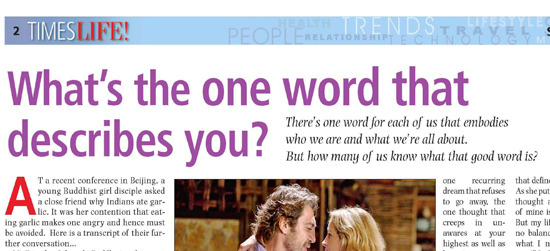
  • What’s the one word that describes you?

    An interesting article by Vinita Dawra Nangia with an even more interesting question. This is the part that got our attention.

    […] a word attraversiamo, which she is told means ‘Let’s cross over.’ However, it takes her an entire year and a journey through three countries to decide that this is the word she wishes to define her life by. The word denotes coming to terms with something, holding the hand of a loved one and helping each other cross over, coming to a decision about life and about yourself and deciding what or who your heart really beats for. Quite often most of us are dithering on the edge of a discovery or decision, hesitating to take the step that takes us over to the other side, waiting for a sign, a prophecy. And then comes the epiphany, and we cross over. A beautiful word. Attraversiamo.


  • Make do

    Failures are often not the result of limitations but the result of our own will. ‘Making do’ is making great design happen, whatever the circumstance.

    Andrew Twigg

    What an end to a very interesting article on how to look at the creative business. This last line makes us wonder whether we can apply the same message to life as well.

    Read the whole article here.


  • Criticism and Critics

    The objections have been so intense and the effort so concerted that it does not feel out of place to ask if there is a deeper intent, a deliberate effort behind all the critiques, objections, characterisations and dirty tricks that the movement is attracting. Nothing is easier in argument than to either characterise the other side with adjectives of your choosing and to inflate a germ of doubt that you can plausibly detect into a full blown epidemic of distrust or try and denigrate the credentials of those one is opposed to and to focus on who they are rather than on the idea that they represent.

    Part of an excellent blog post on criticism by Santosh Desai.

    This part in particular struck a chord with us, as it dives into the world of intense objections and hidden motives. This reflection prompts us to ponder the role of criticism and the strategies often used in such discussions.

    It highlights a common tactic in arguments – the use of strong labels to paint the opposing side in a certain light. It’s a reminder that it’s easy to throw around labels that fit our narrative, which can lead to an atmosphere of doubt. The notion of blowing a small doubt out of proportion is something we’ve all seen, and it underscores the importance of approaching criticism with a discerning eye, focusing on the underlying intent rather than the emotional language.

    The idea of discrediting the credentials of those we disagree with is another aspect Desai points out. This approach shifts attention away from the actual idea and onto the people presenting it. It’s a tactic that can sidetrack discussions and cloud the real issue. Desai’s perspective encourages us to stay on track and focus on the essence of the argument, regardless of who’s voicing it.

    In the context of creative work, these insights are incredibly relevant. They remind us to approach criticism constructively, evaluating ideas based on their worth rather than getting caught up in the tactics used to present them. Recognizing the strategies that can muddle discussions empowers us to engage in meaningful conversations that lead to growth and innovation.


  • Big Data

    Guy Laurence, ex-CEO Vodafone UK on Data

    A thoroughly engaging article from 2011 by Simon Rogers when the term information overload was new, and big data had not found a place in our daily conversation. Mr. Guy Laurence, then CEO of Vodafone UK shared his unique relationship with numbers and customers in this article, and talked about on how to use data to drive business decisions effectively. The Q&A session at the end, fun 🙂 From the very first issue (Data) of Think series from Google (Think Quarterly), which has now evolved into Think with Google.

    Posting a part of the article here. A fascinating read. Check out the whole thing here.

    A few seconds after midnight on New Year’s Eve, 2010. Numbers start flying across a bank of screens in a large darkened room. London: 1,170,000; Glasgow: 115,000; Manchester: 75,000; Leeds: 70,000… The numbers scroll on as the black-clad tech team look for signs that the system might not be able to cope.

    It could be a scene from futurist cult film Minority Report, but the room is actually a real one – at Vodafone’s state-of-the-art Network Operations Centre in Newbury, Berkshire – and the figures represent the number of texts sent in the first 30 minutes of 2011. This is pure data in action.

    The man responsible for this scene is obsessed with data – because of what the numbers can help him do, rather than with the ones and zeros themselves. “I don’t have a relationship with numbers, I have a relationship with customers,” says Guy Laurence, the 49-year-old who took over as CEO of Vodafone UK in 2009. “I focus totally on human responses to things; if you smack someone in the face, what would they do? If you kiss them on the cheek, what would they do?”

    Laurence took over a company widely seen as stagnating in third place in the UK’s competitive mobile market. Today, Vodafone is viewed as a powerful success story, with more than 19 million customers across the country. When you’ve got that many customers, the big question is: how do you industrialise something that works for each one? “You can always kiss one customer on the cheek – but how do you kiss 19 million customers on the cheek?” he asks.

    Laurence carries only a few numbers in his head: his company’s ‘net promoter score’ (which tells him exactly how well Vodafone is really doing with its customers) and the competition’s market revenue share. “When you run a £5 billion company you can’t avoid numbers – but if you start with numbers you’ll never innovate,” he says. “You have to take the action you think will work and the numbers follow.”

    Even when he’s about to fly off with his family to live rough in the Masai Mara for a week, for Laurence, it’s all about focus. He left school with one grade E A-level, having fluffed his exams by setting up a candle-making business after he realised that “making money was much more fun”. It’s a pattern repeated when he quit his degree to work for independent music publisher Chrysalis. Eventually he became head of distribution and marketing outside America at MGM. His job was to work out which markets a product would work in.

    He will tell you, for instance, that a baseball movie will only work outside the US if it’s shown in Japan. He worked on the Bond films, including GoldenEye, selling them to reluctant cinema owners who hadn’t screened anything from the franchise in six years. “The last film had been [classified as] a 15. Therefore anyone under 21 had never seen a Bond film in a cinema.” So MGM made it cool – selling the film to teenagers, dads and mums simultaneously with targeted campaigns that fuelled interest.

    As Laurence explains, it’s all about making the data work. “I triangulate an objective assessment of the new technologies coming in, a subjective assessment of the public’s reaction to new propositions, and then I take a punt.” This ‘triangulation’ is the combination of hardheaded data analysis, coupled with business nous. Data is something that informs his hunches – but never rules them.

    Setting up the £5-million Network Operations Centre (NOC) in Newbury was the first expression of this approach at Vodafone. “It’s very difficult to touch and feel a network,” he says, “but at the NOC we absolutely live and breathe data in real time.” Managing 90 million calls and 80 million texts on an average day is a tricky business; a typical 24 hours sees Vodafone carry 45 terabytes of data, equivalent to 11.25 million music tracks.

    Vodafone’s approach is to use data to manage demand before things happen. The company’s plans for the Royal wedding in April include adding extra temporary base stations to cope with heavy network usage. When Take That tickets went on sale just before Christmas and the band’s official website crashed due to demand, Vodafone was prepared for the surge of fans texting one another to check whether they’d got their tickets.

    One of the walls at Vodafone’s operations centre shows connections to 217 countries to monitor how much traffic is coming in from abroad in real time. The data shows that different cultures are ‘asymmetric’, says Laurence. “You can see Polish mothers are texting their sons over here to see if they’re okay, but the sons are not texting back,” he says. “But the French are almost symmetrical – so as the texts go out, the replies come back in. As situations unfold in real time in Egypt or Bahrain, we can see how that affects the network, too.”

    Even a bill being sent by email triggers a whole chain of data events: customer gets bill, most open it; some have a query and call the centre. Forty thousand bills go out an hour but if the centre gets hit with too many queries, billings are dialled down to reduce calls in. It’s about fighting the data overload.

    And we are truly overloaded by data. Governments around the world are unleashing a deluge of numbers on their citizens. That has huge implications for big businesses with lucrative government contracts. In the UK, the government recently published every item of public spending over £25,000. Search the database for ‘Vodafone’ and you get 2,448 individual transactions covering millions of pounds. Information that companies once believed was commercially confidential is now routinely published – or leaked to websites like Wikileaks.

    Laurence says he is ‘relaxed’ about increased demands for transparency. “Companies will become more transparent as a necessity – customers now see that as an essential part of the trust equation.” The bigger impact may come from the technology that is making access to this data a mobile phenomenon. “This industry is de-linking access to data from physical location,” he says. In a world where shoppers can check out the competition’s prices while they’re in your store, keeping control of data is no longer an option.

    But for now, managing the information out there is the priority. Access to information was once the big problem, says Laurence. Then it quickly flipped, through technology, to data overload. “We were brought up to believe more data was good, and that’s no longer true,” he argues.

    Laurence refuses to read reports from his product managers with more than five of the vital key performance indicators on them. “The amount of data is obscene. The managers that are going to be successful are going to be the ones who are prepared to take a knife to the amount of data… Otherwise, it’s like a virus.

    “Where did it all go wrong?” he continues. “My kids weren’t taught that huge volumes of data were great. Was there a university professor who stood up and said, ‘If you have over 100 indicators you’re a good boy’? Because whoever that professor is, we need to shoot him.”

    Laurence has just won a wager with his team over the number of Vodafone VIP members who bought tickets for concerts. His team, based on the data, bet on one number. Their boss, based on what he knows about people, thought it would be higher. Data plus hunch equals a powerful combination.

    Or, as Laurence concludes: “Data on its own is impotent.”